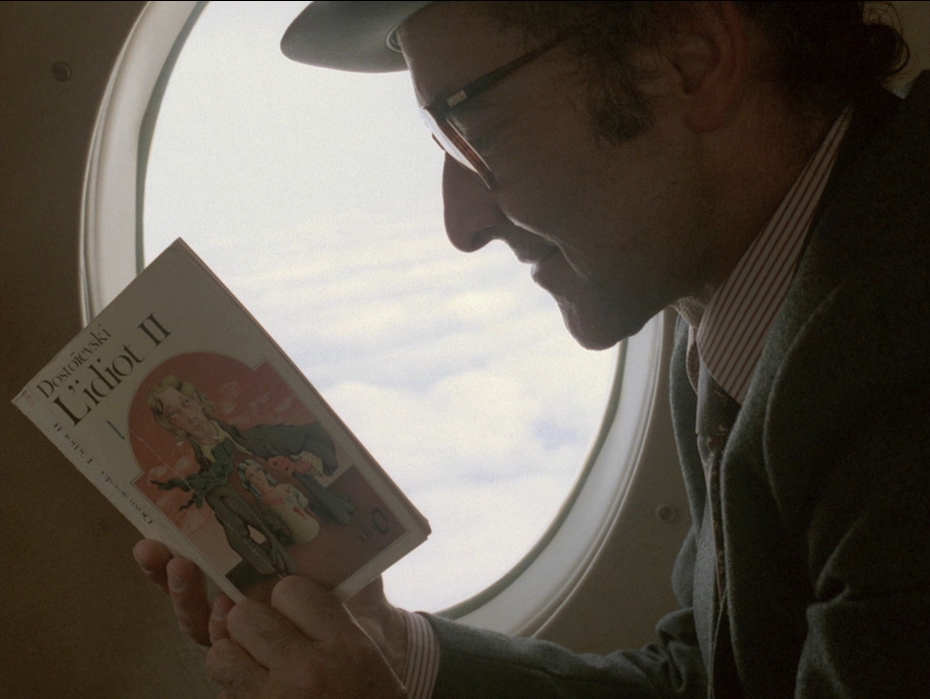
When will the revolution arrive? It has been here a good while, friend, but the thing is: it is both obscurantist and vaguely (maybe more than vaguely) occultist, this accounting for how it persists and does so largely unnoticed. How long has it been going on? Since before Agamemnon, surely. When we start to scrutinize closely we cannot help but begin to see the rhizomes of genealogy and correspondence, their embedded geology. You can field a fact-find anywhere. Consider the name of the boutique operated by Bulle Ogier’s character in Jacques Rivette's Out 1: L’angle du hasard (The Crossroads of Chance). Last week marked the ultimate culmination of my dream project as a film programmer, this being the Calgary Cinematheque Jaques Rivette Masters Series. Regular readers already know this. I have had occasion to quip that we closed the series with Paranoia Week, this involving a screening of Paris nous appartient (1961) on Monday and one of Le pont du Nord (1981) on Thursday. Some folks are liable to harbour limited or limiting notions of what paranoia is or makes available, so I was sure, in my public introductions to those two films, to quote (paraphrase, really) respected eminences in the field: Thomas Pynchon, who I invoked in my intro to Paris nous appartient respective of his assertion that paranoia can be a comfort and even a quasi-religion, far preferable to “anti-paranoia,” a condition “where nothing is connected to anything," which "not many of us can bear for long”; and Robert Anton Wilson, noted wit and theorizer of quantum psychology, who I invoked before Le pont du Nord on account of his having urged us to “view the world as a conspiracy run by a very closely-knit group of nearly omnipotent people,” and to “think of those people as yourself and your friends.” The paranoid strain in Rivette is of course not limited to the two features we screened at the Globe Cinema last week. It surely begins with his feature debut, Paris nous appartient, yes, but then it continues very clearly through such masterpieces as L'amour fou (1969), both versions of Out 1, especially the twelve-hour Out 1, noli me tangere (1971), Le pont du Nord, and later, in variant form, such films as Haut bas fragile (1995) and Secret défense (1998). We might legitimately say of the paranoid strain in Rivette that it is “quasi-religious” and that it involves the imaginative hijacking of the paranoid mindset, supposition of a cosmically vast conspiracy of friends, such that the paranoid mindset betrays its availability to and for emancipatory projects. In her book-length study on Rivette for the University of Illinois Press, scholar Mary M. Wiles pinpoints the specific ways in which all this business is essentially already in play insofar as pertains to that debut narrative feature. “In its concurrent classical and cold war conspiracy scenarios, the film draws an implicit parallel between antiquity and the contemporary world, between theater and cinema, between the dramaturge and the film director, and in this way re-presents the quotidian world of postwar Paris with the force of ancient ritual.” Wiles opposes “the subcultural, communal student ethos of the Théâtre National Populaire” with “threat of co-option by capitalist speculators,” extensive of a system of control “no longer visible or identifiable.” The geopolitical context is already eminently paranoid—Paris nous appartient is released two years before Pynchon’s V—but it is precisely the theatrical adoption of ancient ritual in the paranoid geopolitical context that presents itself as the launchpad for new/old mythologies and countercultural praxis. Because Rivette believed devotedly in cinema as an “impure art” assimilating elements of all those to have preceded it, Wiles has much ground to cover when it comes to the numerous influences on any given Rivette film, which will tend to come from popular cinema, theatre, literature, music, operatic dramaturgy, painting, the plastic arts, radical politics, anthropology, et cetera. Though her study is fairly exhaustive, two glaring omissions stood out to me when I read Wiles’s book. Though she mentions the influence of early French serials (on Paris nous appartient especially), she eschews direct mention of the films of Louis Feuillade. Likewise, she makes only passing mention of the Situationists and May ’68. The latter exclusion is a little difficult to comprehend. It did not seem to me possible to present Paris nous appartient and Le pont du Nord to audiences without establishing them as collaborative cinematic works which exist on opposite sides of a provisional line demarcated by May ’68. Those famous May ’68 graffito aphorisms—“take your desires for reality,” “under the paving stones the beach,” “it’s forbidden to forbid”—are already very much the stuff of Rivette’s poetical group interventions. It also bears noting that there is a historical correspondence between the birth of the nouvelle vague and that of the Situationist International, the latter movement more or less coalescing around unofficial figureheads Guy Debord and Michèle Bernstein, who were married in 1954 and founded the movement, so to speak, in 1957, the same year as the release of Francois Truffaut’s short Les mistons, starring Gérard Blain and Bernadette Lafont, and the year after Rivette’s first short, Le coup du berger. Around the time Rivette is mired in efforts to complete the protracted production and post-production of Paris nous appartient, Michèle Bernstein publishes two louche youth culture novels in an effort to raise funds for her and her husband and their burgeoning movement. In a 2008 Semiotext(e) edition of 1960’s All the King's Horses, the first of these two novels, Odile Passot addresses, in her Afterword, the influence of Marcel Carné's 1942 film Les visiteurs du soir and how in Bernstein's novels Paris becomes a kind of Medieval forest. This not only sounds a lot like what is going on in Rivette’s films, it is in fact a principle with a vivid genealogy. To transform the urban environment by way of a kind of ambulatory group necromancy is what we would these days call “psychogeography.” The Situationists called it “derivé,” and before them, in the 1930s, the Surrealists, under the leadership of syndicate boss André Breton, indexed the same practices using the term “disponibilité.” In the 19th century the psychogeographer was simply called a “flâneur" or “boulevardier.” Rivette’s films very often seem to comprise above all a salubrious combination of psychogeography, archaic (usually explicitly matriarchal) myth/ritual, and the geopolitics of a paranoid and oblique post-atomic age. Extending too much credence to the especially paranoid nature of the post-war landscape is probably inadvisable. Here is a nice point to come back to the serials of Louis Feuillade, sort of like the Netflix of nineteen-teens Paris, and especially 1915’s Les vampires, released in instalments the same year that brought us Griffith’s The Birth of a Nation, though, running in its compiled entirety at seven hours, it is three hours and forty-five minutes longer. The second of the three most prized of Feuillade's serials—sandwiched between Fantômas (1913) and Judex (1916)—the ten episodes of Les vampires feature shifting identities (adopted or abandoned like so much costumery), massive criminal conspiracies, beheadings and executions, necromancy and cryptography. And, uh, parkour. A characteristic title card at the opening of episode seven, “Satanas”: “Enslaved by the hypnotic gaze of the bandit Moréno, and later made his mistress, Irma Vep has assassinated the phony Count de Kerlor, Grand Master of the Vampires.” Keeping with the vertiginous slippages and rearrangements of the series, the subsequent episode will rapidly make mincemeat of most of these assertions. For a time we will be asked to consider the possibility that Satanas is the actual Grand Master of the Vampires. By the end of the tenth and final episode? As critic and essayist Luc Sante contends, respective of Rivette’s Paris nous appartient rather than the Feuillade, which the summation would suit equally well: “you will not arrive at a decipherable code.” A large part of why Les vampires was so iconic for the Dadaists, then the Surrealists and many who subsequently followed, has to do with the bewitching presence of the chameleonic and wildly anarchic persona of the great Musidora, who stars as cat-burgling super-villain Irma Vep. A recent edition from Atlas Press of scene-making opportunist Louis Aragon’s not-very-good 1921 roman à clef Anicet or the Panorama: A Dadaist Novel features an image on its cover of Musidora, succubus of the id, licensed out for a bit of foppish fan fiction. Louis Aragon was born near the end of the 19th century, in 1897. Musidora was born in 1889, a little over a month after Nietzsche goes mad in Turin, thereafter spending the final decade of the 19th century insensate and incontinent at his mother’s house, finally dying in August of 1900. If the nineteen-teens and the 1960s were paranoid and crazy, they don’t have much on fin de siècle Paris, with its anarchist bombs going off in cafes on the regular and its various lunatic personalities the likes of Alfred Jarry, Léon Genonceaux, and François Claudius Koenigstein, A.K.A. Ravachol, the anarchist bomber executed by the state in 1892. I like to imagine a version of Fritz Lang’s The Testament of Dr. Mabuse in which Nietzsche is the Mabuse figure, and we keep cutting back to him, drooling and essentially comatose, as all manner of heinous Feuillade-grade madness erupts hither and thither across the European Continent, the intimation being that the non compos mentis philosopher is orchestrating all of this sordid business from somewhere deep in his sinister and inscrutable psychic recesses. It might make a better novel than film, and I suppose we can only lament that Paul West is no longer around to give it the old college try. We know Thomas Pynchon must have had Louis Feuillade and Les vampires in mind when he was writing Against the Day, a wonderful 2006 novel whose opening section would appear to perhaps make the all too credible case that the 20th century properly commences with the 1893 Chicago World’s Fair, which is also featured in Michael Almereyda's new film Tesla. Nikola Telsa and Sigmund Freud were both born in 1856. Henri Bergson was born three years later. Alfred Jarry, father of ‘pataphysics, studied under Bergson, and you can detect the influence very distinctly in 1897’s Days and Nights, Jarry’s first novel. In Michael Almeryeda’s 2018 documentary short The Lonedale Operator, the title appropriated from a D. W. Griffith, the film’s subject, the great poet John Ashbery, discusses his immersion in the serials of Louis Feuillade when he, Ashbery, was a temporary Parisian in the mid-to-late-50s, a habitué of the Cinémathèque Française. Between 1961 and 1962, Ashbery, Kenneth Koch, James Schuyler, and Harry Mathews were involved in creating and disseminating a short-lived literary journal called Locus Solus, named after the 1914 novel by Raymond Roussel. If we think of Joyce, Proust, and Kafka as the preeminent fathers of literary modernism, it has long been my contention that we do ourselves a disservice, as leaving out Jarry and Roussel is altogether unconscionable. I feel like I was myself remiss in neglecting, when I read it a year ago this month, to link (until immediately after having read it) Mathews’ 2004 novel My Life in CIA to the emancipatory ludic paranoia in the films of Jacques Rivette. When I read, in October of 2018, the third-ever edition of Joseph McElroy’s gigantic Women and Men, originally published in 1987 and a signed-by-the-author copy of which I purchased directly from its most recent publisher, Dzanc, I could not help but notice parallels with Rivette’s Out 1, noli me tangere, which I had only recently been able to view for the first time; both the McElroy and the Rivette are uncommonly long works that are urban, paranoid, and concerned with the domain of the conspiratorial—network narratives featuring a male and a female protagonist who almost completely fail (in McElroy's novel completely fail) to directly interact, with the theatre groups of Out 1 finding their equivalent in Women and Men in the form of the production of a fantastically odd sub-sub-Verdian Hamlet opera. Out 1 features a monumental performance from incandescent Rivette regular Juliet Berto. On the periphery of Feuillade's Les vampires hovers a mysterious personage named Juliette Berteaux, who an insert shot tells us lives at 3 rue Tourette, Paris, 11. What are we to make of all this? Evidence of a permanent sate of transtemporal revolution? Why not a religion? Have others not coalesced out of (or around) far less?
Wednesday, November 11, 2020
Wednesday, November 4, 2020
Open University for the Trans-Armies Database & Future Classics: cinetagmatics_015
15.1. The great Thai artist and filmmaker Apichatpong Weerasethakul has just released a new short entitled October Rumbles, less than five minutes in length, which you can stream for free over at YouTube (through November 12th). Existing as an extension of an exhibition entitled "Third Realm" (curated by Vancouver’s Polygon Gallery), Apichatpong asserts of his short that it seeks to relay a tenuous experience of grounded comfort in the context of pandemic. “I was really longing for physical touch, the act of embracing someone. But after the coming of the rain and seeing all this life around here, I realized I didn’t need any of that. There is enough life here. So I am really content now. That is why I’ve made a number of short films, including this one, all of which involve this rain. My Colombian movie also ends with a long rain. I feel all this connection…and closure maybe.” The film features rain and wind, to be sure, as well as a suspended sheet, liminal, buffeted by the elements, behaving not unlike a sail, made effulgent with invisible force, but also able to become a screen and as such a portal. Extremely truncated running time means one will tend to make a couple strong, immediate associations; the extent to which these stick in the mind may prove testament to the strength of the work. One of my one-hundred-and-three current obsessions is the edition of The Essential Poems of Jim Harrison put out by Copper Canyon Press last year. The opening poem, from 1965, is called "Poem," and it begins "Form is the woods,” followed by a colon. October Rumbles also causes me to reflect for the first time in many years upon my high school drama teacher, a friendly man with a melancholy edge, and how excited he was about the large black scrim at back of stage in the school’s fancy new theatre, opened during my final year of high school. I played Sir Andrew Aguecheek in Shakespeare’s Twelfth Night on that stage, a part supremely suited to my specific species of ungainliness.
15.2. Scott Frank is responsible for some good stuff, and a sufficient number of plaudits from noteworthy sources send me off yesterday to investigate his new limited Netflix series The Queen's Gambit, the opening episode of which, despite its general fidelity to convention and to my considerable surprise, was so astonishingly powerful...I had to take a short break. As I have insisted before, the actress is generally my principle point of identification in cinema; in the opening episode of The Queen's Gambit, what is perhaps most overwhelming for me is an experience of self-recognition. As a child I was able to produce hallucinatory phenomena on the walls and ceiling of my bedroom—generally relating to language and phonemes, intimations of a future vocation—and downers always had a capacity to stimulate me more than uppers, a case of what is sometimes referred to by behaviourists et al. as “paradox reflex.” In these ways and others I am uniquely situated to identify with the chess prodigy orphan Beth Harmon. There is also the matter of the correspondence of parts within an overarching cohesion of design, local particularity as micro-composite, likewise a crucial asset of the compact new Don DeLillo novel I had read in its entirety the previous day. A person I respect had stated online that he did not at all take to the opening episode of The Queen's Gambit. Everything “irked” him. “Directing, writing, performances, approach to period environments. As for coherence, there was way too much.” During my breather following that first episode I posted a reply. “There is not too much coherence in the first episode of The Queen's Gambit. Maybe the wrong kind? From the standpoint of an ‘orientation’? There is certainly no more coherence (the coherence of specifics in relation to the general) than there is, say, in the music Johann Sebastian Bach, which represents, of course, the sublimity of coherence itself.” As for a core theme integrating the series: the natural congenital gift, phenomenal kernel of freak genius, lightning in a bottle, is the unnatural within the natural, the aberrant deviation never without its proper, situated sense, the right example always the example of example itself. They say: “the exception that proves the rule.” What they mean: the rule of the incorporated exception.
15.3. When it first played theatres in late 2011 and early 2012, I had mixed feelings about David Cronenberg’s A Dangerous Method, despite my being an ardent fan of Cronenberg from way back and keen to apprise his angle on the subject matter at hand. I had doubtlessly deemed Christopher Hampton’s screenplay, largely adapted from his own earlier play, the prime culprit, in a manner similar to how just a few years earlier Steven Knight’s script for Eastern Promises had struck me as that film’s mortal weakness. What was absolutely clear to me upon first seeing A Dangerous Method was that Cronenberg’s collaboration with Peter Suschitzky, his regular cinematographer since 1988’s Dead Ringers (an epochal masterpiece), was somehow managing to go further and further, a contraction and purification that nonetheless felt increasingly expansive, searching, bold. Suschitzky and his operator(s) consistently set up some of cinema’s most distinct and remarkable close-ups for Cronenberg. You don’t really see anything quite like it in Suschitzky’s work with other directors. Cronenberg and Suschitzky appear to enjoy shooting close-ups with a 25mm lens, but this does not seem to offer a satisfactory explanation; there has to be a secret ingredient, a patent, a trick which remains concealed. The close-ups Cronenberg and Suschitzky shoot of Sarah Gadon in A Dangerous Method and then again in 2012’s Cosmopolis are especially revelatory. They are liable to leave an indelible mark. My experience of A Dangerous Method when I revisit it late in the first half of October, 2020, is an altogether different experience, though clearly the earlier viewing leaves its apparitions like a film (in the sense of a thin layer) upon the film (in the sense of celluloid). Something immediately leaps out at me in the opening sequence, set in 1904, in and immediately outside the Burghölzli Clinic in Zürich, Switzerland. “Good morning. I’m Doctor Jung, I admitted you yesterday.” Carl Gustav Jung (Michael Fassbender), famous clinical psychiatrist turned early adopter of the talking cure, explains the latter newfangled method to Sabina Spielrein (Keira Knightley), institutionalized for hysteria and herself likewise a real historical figure and future analyst of renown. There is no couch as of yet. Sabina sits in a chair, spasming and experiencing autokinetic contortions, another chair situated behind her. Jung explains: “So as to distract you as little as possible I am going to sit there. Behind you. I am going to ask you to try not to turn around and look at me…under any circumstances.” The actor Michael Fassbender enunciates these words in his customary British-accented English, but I am immediately aware of a statement that is properly made in a particular Swiss-German. It is an unusual sensation. Jung’s eerily reasonable paternalistic directive is bound to a historical and institutional staging as it is to a particular sense of Protestant milieu. With respect to A Dangerous Method, Cronenberg has regularly made a point of emphasizing the period’s mania for letter writing, insisting that in the Vienna of the period there were a good many mail deliveries daily, such that if a person sent a letter in the morning they could reasonably expect a reply by late afternoon. Cronenberg has pored over the reams of correspondences written by his film’s referent personages, and if each was written in the German of its particular space-time (one unique German for each unique German correspondent), the filmmaker has had to fall back to reading them in English translation. After Spielrein has made some headway in her recovery, Jung employs her as a hospital helpmeet. A crucial sequence has Jung subjecting his wife Emma (the aforementioned Sarah Gadon) to a word association exercise whilst she is hooked up to a galvanometer, Spielrein in another part of the room analyzing the data as it is produced in real time. Though she has not been told who Emma is, the sequence concludes, the session now terminated, with Spielrein intuiting that the other woman must be Jung’s wife, a fact made evident by the mechanics of its suppression. The galvanometer scene, which contains more cuts and more frequent cuts than any other scene in the film, is all the more fascinating because it involves a three-way interaction mediated by machine, such that the galvanometer and the cinematographic apparatus become a perverse intermachinic assemblage in service to a demonstration of how there is speech speaking beneath what speech is explicitly enunciating. Carl Jung and Sigmund Freud (Viggo Mortensen) do not speak the same German because they do not occupy the same space-time. Yes, Freud is Viennese and Jung is Swiss-German. Freud is, more specifically, a Viennese Jew, Jung a Protestant whose father and a number of whose uncles were pastors. Carl Jung, unlike Freud, is a Wagnerian. As a Viennese Jew, Freud thinks in terms of self-protection. Psychoanalysis needs to make a convincing case for its legitimacy as a serious science, because otherwise it opens itself to paranoid attacks from Anti-Semitics. Jung believes in the primacy of the archetypal-spiritual, a Germanic mythology which history will prove to be in significant respects proto-Nazi. Like Hölderlin, Wagner, and Nietzsche, Jung is plugged into the archaic power of the Black Forest, a collective unconscious, the bedrock of the Germanic archetypal, a subterranean system. His break with Freud requires a new language, an opposing German, operating at yet another tier, hence: a supplemental nomenclature, from “psychoanalysis” to “analytical psychology.” Sabina Spielrein is a Russian Jew and Wagnerian (exception as rule of incorporated exception, example of example), and so for a time an ideal intermediary between Freud and Jung (each of whose Germans she augments). The sexual relationship between Jung and Spielrein is unthinkable in Cronenberg’s film without the music and mythology of Wagner. The very different intimacy shared by Freud and Spielrein is unthinkable without the history of the Jewish people. Wagner is a fundamental antinomy in recent history, the Nazis representing the aberrant turn of the Wagnerian. We see this in Rosmarie Waldrop’s absolutely remarkable The Hanky of Pippin's Daughter, a 1986 novel taking the form of a sisterly deflection, a series of operational unbindings, which happen to persistently retrace the coincidence of rifts driven by the spectre of Wagner into two marriages over two generations, rifts which open up a space for Wagnerian infidelities (and the Jew). The real life Sabina Spielrein was shot dead in 1942 by the SS, along with her two daughters, at Zmievskaya Balka, or "Snake Ravine,” near Rostov-on-Don.
15.4. As chair of the Programming Committee for Calgary Cinematheque, my tenure can theoretically extend as far as six years and no more. My one big ambition has been to mount a Jacques Rivette Masters Series, and the thing has come to be, so, really, I can retire anytime…pretty much, from everything. The attendance numbers haven’t been good, but that’s COVID for you. Who cares? I’m in paradise. This is the final week of the series. Unofficially: Paranoia Week. On Monday we showed Paris nous appartient (1961) and tomorrow we show Le pont du Nord (1981). Last week was the two extant films of the Scènes de la vie parallèle, Duelle and Noroît, both from 1976. Introducing Duelle, I told the audience that the film is among my top ten of all time, the one I will always tend to choose as my favourite Rivette if called upon to choose. This is no longer so. Of the five Rivette films we have screened theatrically thus far, it is Noroît that benefits most extraordinarily from being seen and heard in a theatre. It is currently my favourite film of all time. Period. Both Duelle and Noroît introduce the novelty of incorporating improvised music into the diegesis (the on-set scene-work documented by the camera and location sound equipment). I have seen both films numerous times, and I am totally aware of this, of course, but experiencing Noroît in a theatre was akin to hearing that music for the first time. Rivette is combining Jacobean tragedy with the staging concepts of Artaud and Cocteau, a little bit of Fritz Lang and Nicholas Ray thrown in for good measure. His films are above all about a praxis that realizes itself through collaborations with actresses, and here are the musicians in Noroît, engaged in aleatory improv, collaborating directly with the actresses from within the tableau. Marguerite Duras is purported to have once told Rivette that it was in hearing one of his films that she arrived at the ability to see it. Well, slightly gnomic as that may scan, it is precisely what happened to me at our screening. What does improvised music share with the affect of the actress? Be it supernal beings the likes of Bernadette Lafont and Geraldine Chaplin, or be it Keira Knightley, whose wonderful performance in A Dangerous Method was perniciously scorned far and wide? Consider what the philosopher Gilles Deleuze says about the “logic of sensation” and the art of Francis Bacon: “what fascinates him are the invisible forces that model flesh or shake it.” This will have a bearing on things Deleuze offers us respective of affect and faciality in his two books on cinema. Those invisible forces also pass through improvised music (perhaps like a northwesterly). Space is the place, there are other worlds they have not told you of, signals abound, crisscrossing in all directions, and a person can be a transmitter, or a transmitter among transmitters, in the groupuscule context, the intermachinic one. I got to talk to the great avant-garde bassist Barre Phillips at length during the 2019 Festival International de Musique Actuelle de Victoriaville. Barre was there to play a solo concert, a man and a legend eighty-four-years of age. I asked Barre about collaborating with Jacques Rivette on 1980’s Merry-Go-Round. He was surprised and pleased to be asked, this not being something that has happened often, if ever. Barre was happy to share the whole wild tale. After telling it, he paused for a moment, and said with a mixture of mystification and mirth: “Jacques Rivette. Yeah.”
15.5. Nietzsche, The Case of Wagner (Turin, 1888): “Only sick music makes money today; our big theatres subsist on Wagner.”
15.6. Jacques Rivette, in discussion with Mary M. Wiles (Café de la Bastille, Paris, June 1999): “That’s how we did Noroît, the film was a disaster, but I have good memories of it because filming it was really crazy, in four weeks, at the ends of the earth in Brittany, you can just imagine…”
15.7. I like the film critic Nick Pinkerton, despite my seldom harbouring anything other than outright contempt for jobbing film critics. Pinkerton is no more than a few months younger than myself and, I believe, from Cleveland, Ohio. He was a kid in a punk scene not unlike the punk scene in which I was a kid. Pinkerton is amusingly sardonic, erudite, keen of mind and enterprise. For a while, back when I was working at The Calgary Drop-In and Rehabilitation Centre, I used to read Pinkerton’s “Bombast” column over at the Film Comment website. This is where I believe you got the best of Pinkerton. Back then. There was no real conformity to house style in that column, and he got to pursue his essayistic fancy wither it led, perhaps like a wisecracking 21st century Robert Musil-type. Dig? 2020, global pandemic, a lot of the jobs have dried up, especially the more traditional ones. Film Comment has folded, Alpha 60 has crashed, precarity reigns. Pinkerton is writing on his own terms. A “Substack” called “Employee Picks.” You can send him five dollars a month to keep the aspidistra flying. That’s what I’m doing. In his lovely and involved piece of October 23, Pinkerton gets into the nitty gritty and the gris gris of the current moment. The COVID moment. Quoth Pinkerton: “This is a moment of utter catastrophe and, as such, a moment of opportunity—the opportunity, as institutions show their asses and existing structures display their frailty, to think of how to work outside of those institutions, or how to create alternative structures that better service everyone, and not just the managerial caste.” I am thinking of this at a crucial moment in the final episode of The Queen's Gambit—which is sort of stupid, totally predictable, and utterly sublime—when a long-distance phone call from New York to Moscow suddenly drops me into an unusual and touching socially-distanced solidarity (less than ten people) that actually makes me cry. Tears. Tears of actuality, the evidence that speaks for itself, no matter how avidly the choked voice may protest their verity. American individualism versus the Soviet Citizen as Continent-Sized Granite Block. You might well expect chess prodigy orphan Beth Harmon, representative of the rule of incorporated exception, to stand for American individualism. I ask you to self-identify here the way I could not help but do. Consider the possibility that there are solid connections already situationally in place for you and concerning which you are not at this moment properly conscious.
15.8. In viewing the very short Apichatpong Weerasethakul film October Rumbles. Right. Able basically to synthesize two key imaginative correlations. Right. Jim Harrison poem “Poem,” scrim in fancy new school theatre. But then the very short film is over and there you remain, seated, imagination still present and accounted for. Always the case with me, always: more correlations incoming. Okay, right. Sheet, scrim, sail. Is there not that audiovisual essay by Adrian Martin and Cristina Álvarez López? Concerning the films of Jean Epstein? Yes. Yes there is. Well, what are you waiting for, dial that shit up. Here on Vimeo. “The Thinking Machine 9: The Sea Speaks.” Cue video. Okay, it’s not the exact video I was looking for. Correlates just fine, though. Correlates great. Jean Epstein in Brittany, “you can just imagine…” God said let there be wind and sea. And saw that it cohered. Was good.
Wednesday, October 28, 2020
Open University for the Trans-Armies Database & Future Classics: cinetagmatics_014
Though I have not read Søren Kierkegaard’s 1849 book The Sickness unto Death since I was a teenager, it is the kind of book that is likely to stay with a person, especially the kind of person, myself being an example, who was once upon a time a pubescent male prone to fantasizing about suicide as often as sex. Kierkegaard was a highly unusual sort of ironist, the authorship of many of his most important works attributed to pseudonymous personages, incorporeal emissaries sent into immaterial trenches to file their exhaustive—and very often harrowing—reports. The name signed to The Sickness unto Death is Anti-Climacus, which I am sure you’ll agree is pretty funny. The book is a disquisition on the subject of despair, and though I do not have a copy on hand, I am confident that my recollection is more than halfway adequate when I summarize matters by locating its conception of despair in the problem of the self. We might allow ourselves to overshoot the mark concision-wise and just go ahead and claim that Anti-Climacus argues that there are really two kinds of despair: 1) the despair in the self at the having of a self; and 2) the despair of the balkanized self that insists to the desperate last on its constituting a self. Early in the book, Anti-Climacus does a pretty famous thing. The suggestion is posed that the self is a relation which relates to itself. Okay. Well...sure. However, if this conscious self is its self-relation, the thing and the relating to the thing, then the proper site of the self exists at a supplementary tier, which is to say the consciousness of the relation, the relation that relates to the original relation. It is a perfectly sound formula. The thing is: it’s extremely abstract. Everything I have just written ultimately pertains to ideality and the domain of the transcendental. Not much here of the earth and the glands—of organs and odours or objects organic. Let’s toss aside the pretence of addressing Anti-Climacus and acknowledge that this line of discursive development finds us precisely where Søren Kierkegaard wants us. Kierkegaard takes us to the abstract realm of immaterial or impersonal despair (the impersonal despair of the person who insists on being a person), because he is above all a spiritual philosopher and his conditional irony aspires to venture as far into a vacated and arid transcendental as it can manage before it is ultimately time to take a leap of faith, turning our will and our lives over to God, or, if you prefer, eternity, the open field of fullness and potential, categorically opposed to the pitiful and finite self that clings to its habits and pretences as though they were a life preserver (when in fact they are despair its very self). The relation that relates to the relation is not God. It is very much not the bird of the air nor the lily of the field praised in Christ’s sermon on the mount. It is not even shit (no odour). This is despair. Have you been through the wringer? Really and truly been wrung? Do you suffer from one or another form of brain sickness? Have you done the ring-around with the therapists and psychiatrists? Is the list of medications you have been prescribed over the years a large one? For those of us who answer yes to all these questions and have lived to tell the tale: we might well counter, okay, yes, all well and good, Søren, but my problem is not the transcendental overseeing of the self as a relation with itself; my problem is the central nervous system. Something happened to me just about two years after I got clean and sober. This was in the fall of 2015. I experienced my first major depression in sobriety. It had very little to do with sadness or despond. Yes, the mood is basically a disaster, although it mostly tends to feel like a pronounced absence of mood. Additionally: you are in physical pain, you have zero energy, your digestion is shot, cognition lags, manual dexterity is pitiful, and presiding over all is a generalized experience of ongoing atrophy. In 2015 I didn’t know what had hit me. My psychiatrist gave me a note, and I was able to take a month off work. I sat in the thing and I progressively adjusted. This is the thing, here I am with the thing, and this thing too shall pass. This is what I told myself. As I have subsequently done every fall. September or October, every year since 2015, like clockwork. This may sound incredible to you, but at this point it is basically a cakewalk. I am a low bottom drunk and former drug addict. What do I mean by low bottom? A nightmare you cannot comprehend unless you’ve lived it. People like me, serial alcoholic visitors of emergency rooms, were once thought hopeless. We were consigned to death. Nothing can be done for a poor soul so far gone. So what happens to me in September and/or October every year is eminently livable. As such it is a thing I don’t mind observing. You know, like a journalist, say, sure, but also in the manner the Jewish people observe Passover on the mirror-side of the calendar. Sometimes I reflect. People I have met, people no longer with us, survivors and fatalities both. The first of five treatment centres I went to was in San Clemente, California. Back in 2006. One gentleman staying there walked off the property, rented a hotel room, and proceeded to get drunk. He severed the ulnar arteries in his elbows, had second thoughts, went to the front desk for help, and died on the lobby floor. I think of the young woman in the last psychiatric ward in which I was held. This was in 2009. She had stepped into a cold shower fully clothed and came dripping wet and shivering into the common area, mute, saucer eyes wide with horror. I shan’t ever forget her. Then there is the woman I met in detox in 2013 who told me the story of how she may or may not have stomped a man to death with her heavy boots in Tokyo after he assaulted her on the street. These are my people. This is a lived experience of the world I know intimately. I am not doing well this week, but my bad days now are incomparably preferable to my best days then. I got clean and sober through twelve-step recovery. I am in a position to know that there is actually helpful material in Kierkegaard. My salvation is in fact right here in the living eternal immediately at hand. In his recent book At the Center of All Beauty: Solitude and the Creative Life, Fenton Johnson seeks to understand and to consolidate his own spiritual practices by way of consideration of famous solitaries. He takes a basic precept from Marianne Moore: “the cure for loneliness is solitude.” This is exactly right. One passes through the struggle and suffering of loneliness in order to arrive at the solitude that gives and keeps on giving. Johnson: “The measure in which your solitude is hard is the measure of the reward it offers.” The works of both Emily Dickinson and Eudora Welty bear testament to this, progressively, over the course of their lives. Both Dickinson and Welty pass through longing and arrive at the “fountainhead” of truth. What did Henry David Thoreau discover through silence and solitude at Walden? In his own words: “I have more of God.” Zora Neale Hurston, inventor, so to speak, of her own hybrid religion, came to believe foremost in “the eternal in beauty.” Of the great painter Paul Cézanne, Johnson has this to offer: “I can say he’s crazy—perceiving a soul in a sugar bowl?—or I can listen to what he’s telling me, in his letters and in his work, which is that the sacred exists in every particle and atom, the sacred is what is, and my job is to pay sufficient attention so that I too can perceive the psychology of the earth—its living, feeling, expressive self, made manifest in rivers and seas and mountains and tornadoes and earthquakes.” Indeed, yes, when I speak of “observance” it is precisely just this “sufficient attention” to which I direct you. Is it pantheism? Don’t knock it ‘til you’ve tried it. This is what my practice looks like. It is my way. I have to do it alone, and certain kinds of reminder cannot help but serve me. Depression, for example, the lassitude that enters uninvited to once again teach in its efforts beyond mercy. A living poetics, an engagement with the eternal, already presupposes an expansion beyond the bondage of self and a reconfiguration of the transcendental, the problem in Kierkegaard that coordinates the conditions for the spiritual solution. Both Fenton Johnson and I had many lovers in the past but, at a certain point, became provisionally celibate. Anybody with a cursory grasp of either psychoanalytic theory or the reason the French are wont to call the orgasm “la petite mort,” will know that sexual intimacy, like a profound spiritual experience, will have a tendency to precipitate the dissolution of self/ego, the experience of a folding, and/or the collapse of amorous parties into one another on the other side of a threshold. I often think that the best sex is like electroconvulsive therapy. It is not certain who it is that will emerge. Maybe Dr. Jekyll, maybe Mr. Hyde, maybe a sputtering codependent wretch. This is part of the ecstatic terror at the heart of the work of Geroges Bataille, especially as regards his fiction. In his own preface to the short story “Madame Edwarda,” the piece in question originally published under the Kierkegaardian pseudonym Pierre Angélique, Bataille writes of “a certain lacerating consciousness of distress” and an “unbearable surpassing of being.” In “Madame Edwarda” itself there is a moment when the narrator writes of how “the pungent odor of her flesh and mine commingled flung us both into the same heart’s utter exhaustion.” The same heart. A heart that now incorporates two people. Then later, as Madame Edwarda, organ of God, fucks a cabdriver: “little by little that embrace strained to the final pitch of excess at which the heart fails.” From two to three (with the addition of the cabby). The heart fails. The three-headed heart fails. Bataille’s famous short novel The Story of the Eye likewise stages multiple chronotopal scenarios wherein three participants are drawn into the anarchic eddy of an intensive transference. It is not only the disincorporated elements of the individual participants that may happen to pool together in the whirlpool. In order to elaborate, I direct you to Robert Altman’s 1974 film Thieves Like Us, an adaptation of the 1937 novel of the same name by Edward Anderson, earlier adapted by the great Nicholas Ray for his debut feature, They Live by Night (1948). The themata in play here are already operative in earlier Altman films. Take his first proper feature, 1969’s That Cold Day in the Park, in which a solitary played by Sandy Dennis invites in a boy and by extension her dissolution, or the monumentally great Brewster McCloud (1971), in which a young man who aspires to fly discovers sex and crash-lands in the Houston Astrodome. In Thieves Like Us, Bowie, a young man from the Ozarks, recently escaped from prison and played by Keith Carradine, meets Keechie, played by Shelly Duvall. The young Depression-era innocents are to make love and play Hullygully all in the same day; the socializing subduction through sexual coupling—elevation to a fatuously adult level of interaction—is made evident during and after the couple’s first sexual experience. Bowie playfully sings “keechie-keechie-koo,” repeating the incantation his brutal and drinking-toward-void fellow-prison-escapee friend Chicamaw, malign elder, has previously employed to indicate the teenage girl’s sexual organs (and their implied mediation). Keetchie only assumes that Bowie is being playful; she grins ingenuously. During the consummation of the relationship there is also the ever-present radio, here transmitting the broadcast of an audio drama in which the male narrator reports on how “Romeo and Juliet consummate their first interview by falling madly in love with each other,” the young couple’s as yet jejune bond interpenetrated by the civilizing strain of a “popular” narrative which insinuates into the bedroom the socializing mandate, what the scholar Gayatri Chakravorty Spivak calls “heteronormative reproductivity” (not to be confused merely with the normativity of sexual reproduction involving a male and a female). It becomes immediately clear that this interpenetration of commercial radio colours the childish-intimate bond and ultimately ensures the film’s devastating finale, in which Keechie watches helplessly, two bottles of Coca-Cola in her hands, his and hers, as Bowie is bombarded by a veritable police arsenal. The whole of the social apparatus is indexed in this shattering tableau, bound up with the Coca-Cola bottles. In the subsequent epilogue, Keetchie ultimately disavows Bowie, to whom she refers, speaking to a stranger, as effectively a deadbeat dad who ultimately just weren’t no good and who died of “consumption.” The ever-present bottle of brand-name cola in her hand, once again displayed in the epilogue, contours the polyvalence of that fatal word. Consumption. A sickness unto death. Sure as shit.
Tuesday, October 20, 2020
Open University for the Trans-Armies Database & Future Classics: cinetagmatics_013
My friends Paul and Mark call me Jake, so can you; my real name is Jacob, but that doesn’t matter, it’s just a handle, the one with which I got saddled. When I first, like, started school…well, I never talked to anyone. Sat in the back mostly. And blew bubbles with my spit. The teacher would sometimes call on me for answers and I would give them and then just sit there quietly. It was perfectly fine. Once she asked me to draw the number ten on a board. I did it, but the numbers looked real bad, sort of like two skinny ladies leaning on each other, the skinny zero bottoming-out all belt-around-a-goitre. I felt terrible but just went and sat down. Once after school I got cast in a TV show called Balthazar the Talking Dog. It happened just like that. An old man on the street pulled me aside and asked me if I wanted to be on TV and I said sure, shit, yeah, you know. He said I had the perfect face for it. They made me read some lines to a camera, but that was it. It was easy getting on TV. I guess Paul and Mark aren’t really my friends, they are just on Balthazar the Talking Dog with me. We play three kids who are friends and one of us has a talking dog that fights crime. Every episode, Balthazar fights a new crime, but it is all pretty much the same. It is, uh, cool…I guess. Mark’s character owns the dog and the, I guess, cool part about the show is that Mark’s mom is played by the famous actress Catherine Chestnut. She used to be a famous movie actress but now she’s on Balthazar the Talking Dog. She is sad and angry all the time and she sits in her trailer and drinks bourbon from a coffee cup. Once she called me a ‘little cocksucker.’ Her voice is raspy and deep like Darth Vader, or, like, I guess James Earl Jones, right? Paul and Mark say that her voice is like that because she smokes too many cigarettes. Those Joe Camel cigarettes. What is strange though is that she can make her voice sound sweet on TV. When they turn the camera on she changes completely. I guess that’s acting. The first Balthazar died after four episodes. Paul says that Catherine Chestnut hit him with her car when she was drunk at three in the afternoon, but our executive producer Lance would not tell us what happened. The new Balthazar is better though so it is not a big deal, really. The new Balthazar looks like the old one but he can jump higher and his lips move better so it looks like he is talking. They use bacon on a coat hanger on a boom rig to get Balthazar to move his lips like he’s talking. I do not know how that works. I tried it with my mom’s dog Pepper, but Pepper just jumped up and ate the bacon. My boom rig was a broom. In this week’s episode of Balthazar the Talking Dog, uh, Balthazar fights a ruthless real estate jagoff who wants to steal Mark’s mom’s house to turn it into a parking lot, I think. The neat thing about this show has nothing to do with that, though. The neat thing, that most kids will probably like, is that Balthazar gets to play basketball in this episode. Once he played soccer and the people liked that a lot, so now it is basketball. I recently learned a poem and I was maybe going to ask to read it on the show. Mark said I was an idiot and a fairy. The poem is called “Quaker Oates” by Rita Dove. I think those are really good names both for a poem and for a lady who writes poems. Rita Dove is a coloured woman, or a woman of colour…she’s, you know, black…of African descent…and “Quaker Oates” is called a prose poem which means that the way it sits on the page you wouldn’t really think it was a poem, more like a inter-studio memorandum type deal or a normal thing you would…whatever, whatever tickles your fancy, whatever people write for. I have the whole fucking thing memorized. There is a bit I really like about “breakfast-nooks, fingers dreaming, children let their spoons clack on the white side of their bowls,” and then also it has this great ending that goes “And they come, the sick and the healthy; the red, the brown, the white; the ruddy and the sallow; the curly and the lank. They tumble from rafters and crawl out of trundles. He gives them to eat. He gives them prayers and a good start in the morning. He gives them free enterprise; he gives them the flag and PA systems and roller skates and citizenship. He gives them a tawny canoe to portage overland, through the woods, through the midwestern snow.” Isn’t that fucking great? Except, well, thinking it is great would appear to mark me. But who could really care. That’s not even a question. It is a statement. Like, it is stupid to care about mean bedizened child star halfwits and their what-are-I-have-heard-called aspersions. Also the new Balthazar does not do sex things like the old one did. The old Balthazar would scurry up behind you and try to do sex on your legs; at least that’s what Paul and Mark said he was doing. It got us in trouble when the old Balthazar tried doing sex on the network guy’s wife. Lance had to hall Balthazar off and then apologize like mad. Either Paul or Mark, I can’t remember which, told me that they might have killed the old Balthazar because of all this. I hope not, that sure would be a waste of a dog’s life. Maybe if the new Balthazar starts to do sex on people’s legs we will have to get another new dog. I hope not. I like the new Balthazar a lot. Really. Like him loads. That grin, right? I really cannot imagine that the show, eck, not be, like…you know…it wouldn’t, uh…would not be the same…show…without him…
Wednesday, October 14, 2020
Open University for the Trans-Armies Database & Future Classics: cinetagmatics_012
The nature of my particular fanaticism is such that I prefer to enjoy. So long as it should prove to remain possible, viable. It pleases me to enjoy. I prefer it to the gloomy alternative. That pleasure is pleasing and fun is fun: small children not only grasp these tautologies, they are known to be quite declarative about it. What happens to us? Along the way? There are people out there who only like Scandinavian black metal, K-pop boy bands, or Italian opera. It would not surprise me in the least if out there somewhere exists some fellow who of all the things in this bountiful world only likes Stan Getz live in Stockholm. The onetime Playboy associate editor, Discordian prankster, and psychonaut Robert Anton Wilson liked to perorate on the subject of individual “reality-tunnels,” and we might simply conclude—perhaps too simply—that the issue is one relating to narrowing with respect to these tunnels. We might think of it as a myopia of progressive concretion. It is commonly believed that old people don’t like anything new. Here is one of my favourite passages from any book ever, which one can find in Robert Anton Wilson’s Cosmic Trigger I: The Final Secret of the Illuminati: “Since we all create our habitual reality-tunnels, either consciously and intelligently or unconsciously and mechanically, I prefer to create for each hour the happiest, funniest and most romantic reality-tunnel consistent with the signals my brain apprehends. I feel sorry for people who persistently organize experience into sad, dreary and hopeless reality-tunnels, and try to show them how to break that bad habit, but I don’t feel any masochistic duty to share their misery.” The funny thing about this quotation is that you can share it with, like, one thousands people—as I am sure I have done in my work with my fellow alcoholics and addicts in and outside of a treatment context—and nine-hundred-ninety-nine of them will nod vigorously, maybe even say something approximating “far out man”...then proceed to do absolutely nothing with what they have just pretended to learn. Behaviourists have been telling us for a good while that people don’t want to change their thinking because they believe it is close to the whole of who they are. Challenged on core beliefs and values, people see red, detect an existential threat—the midbrain kicks in. This is the hopelessness of the human being, equivalent to a trout flopping in a motor boat with a hook in its gums. Your programming has tribalized you, you are caught, the platitudes you trumpet not properly your speech. What are the things you like? What is to your taste? Okay, stop talking, you bore me. If I do generally tend to find individual human beings monumentally tiresome, my particular fanaticism habitually directs itself toward an effort to try and enjoy the things human individuals make, alone or in groups. We are talking about specific varieties of things. We are most especially talking about writing, cinema, and music. I want to enjoy these things and appear to have better success than most people, especially professional (ahem) critics. That being said, sometimes, yes, it is all but impossible to enjoy. If I go and see a very bad movie—one I believe to be woefully inept, gratingly tedious, or totally objectionable—my last resort is to revert to sociologist or anthropologist mode, simply trying to figure out what garbled claptrap the bad movie might be expressing about the world in which I live. It is now bad, maybe very bad, so it becomes a patient, and I try to be as patient as I can with the patient, and may earn for my trouble a better command of aliments, which is something I might actually sort of enjoy. When attending two film festivals this past September (and early October), both from my couch (COVID-19 brought Toronto to me) and in theatres (masked and distanced), I did a very good job of enjoying everything, even the things I had to enjoy as a slightly exasperated clinician. The least satisfactory film I streamed from Toronto was a pretty good film that I would probably be willing to recommend: True Mothers by Naomi Kawase. Now, I do not at all think that Naomi Kawase is a bad filmmaker or that her story is bullshit or unworthy (even if it is not terribly original). What becomes a bit depressing for me watching True Mothers mostly pertains to the ways Kawase diverts from her strengths in order to enter territory outside her wheelhouse. This is going to be a problem for somebody who is basically enjoying the film and wants to keep enjoying it. Kawase is not a sophisticated or a manipulative director, at least not when she plays on her strengths. I think of her doing her work directly with the actors, the camera a little off to the side, unobtrusive, the work a work with the possibilities of intimacy and uniquely capable of seducing singular interactions and expressive affects into being. Problems start to accrue in True Mothers’ second third because the power source of the poiesis is cut off by the too-fancy insinuation of structural convolutions and an excess of scenes/sequences that seem to be purely illustrative within the schematic. A work is most likely to lose me if it starts to lose credibility within the parameters of the terms which would appear to be those set by the work itself, rather than its not conforming to a model I have of how all or most works ought to conduct themselves. If you have seen Charlie Kaufman’s most recent film I'm Thinking of Ending Things, a sort of psychogenic rockslide largely framed by the failure of framing, you will be aware of the already notorious scene in which the unstable plurality (mostly) embodied by Jessie Buckley begins reciting as though extemporaneously the famous New Yorker of yesteryear Pauline Kael’s demoralizing pan of John Cassavettes’s 1974 masterpiece A Woman Under the Influence, this being a review that happens to be contained in a Kael collection conspicuously placed earlier in the childhood bedroom of the boyfriend on the receiving end of the embezzled tirade. The review is so hideous as to represent something close to dereliction of duty. A key piece of prosody here involves the sardonic assertion that Gena Rowlands’s performance is something like the “most transient big performance” ever, this a capstone to Kael more or less telling us that what she really objects to is flux itself, as though there were or ought to be no such thing. Well, Cassavettes and Rowlands (and me and Félix Guattari) could not disagree more. The odious David Denby, current New Yorker hack, writes about this scene from I'm Thinking of Ending Things in his review of Kaufman’s film, likewise resorting to the sardonic Kael-lite modality. The narrowness of Denby’s reality-tunnel asserts itself as it always does. Sorry, I'm Thinking of Ending Things is not Stan Getz live in Stockholm. For shame, Charlie Kaufman. Why do I read? Or go to the movies or listen to music? Susan Sontag, abjuring interpretation, rhapsodizes on the erotics of our encounters with art and the products of culture. I want to keep expanding through absorptive self-relation, pulling everything inward, blowing up like Violet Beauregarde in Willy Wonka, Jack H. Harris’s Blob, or the increasingly giant gluttonous woman who tramples over the narrow and narrow-minded small town set and setting of Robert Coover’s John's Wife, that greatest of American novels. My position as to why this is my fancy: I am a special kind of idiot, if not to say a holy fool. Not quite like the Dostoevskian idiot archetypes the great Jean-Luc Godard shows us in his films Soigne ta droite (1987) and King Lear (the same year), if only because a great deal more pleased to be pleased. I think I am more like Dostoevsky’s actual Myschkin, who exists in something close to a state of permanent hyper-stimulated ecstasy. I would caution you to not get too fanciful a notion in your head about what the life or origin story of such an idiot might look like. Communicating online with the filmmaker Jon Jost in the wee hours of the morning, I wrote both of how “my life (in my twenties and a little beyond) was for a considerable period a harrowing nightmare for those tasked by providence with having to love or try to love me,” and of how still now, nearly seven years clean and sober, a special kind of idiot, “People very frequently look at me as though they believe I must be walking around with a pant leg full of my own shit.” Jost responded thusly: “We special kinds of idiots are a tiny minority. And we tend to know it, for better or worse. Many cannot handle it and destroy themselves with booze or drugs or suicide. Some can handle it and make the most of it with whatever they can do. Often in the arts. Sometimes in sciences.” Jost knows. My idiocy is instrumental irony. It is a medicine taken primarily in the form of what I tell myself with nobody else around and how I set out to engineer my pleasure. Jost’s “special kinds of idiots” who constitute “a tiny minority” are the minor persons Curtis White calls “transcendentally stupid” in his recent book Living in a World That Can't Be Fixed: Reimagining Counterculture Today. The world excludes you as too stupid to embrace the platitudes, too intransigent to narrow, and you are blessed. You can have your own expansive scene. You can metaprogram yourself as moulder of your own neuroplasticity. Transcendental stupidity? Consider how French literary theorist Fernand Hallyn assesses metatropological irony in The Poetic Structure of the World: Copernicus and Kepler: “The subject is placed in a transcendent position with respect to his discourse, but only to deny the possibility of making himself the guarantor of transcendence.” Instrumental irony can play inventively with the seat of the absent guarantor. In the novel I am reading right now, Alfred Hayes’s The End of Me, a fallen man in his late fifties, formerly successful, who happens to be the narrator, reeling in the aftermath of a marital cuckolding, beholds in his young cousin (once removed) intimations of an ultimate reckoning. Asher, the narrator, momentarily projects young cousin Michael outside of the domain of immediately accessible sense-data. “He is playing an ironic game with himself as he comes down the corridor. He is in enemy country.” The ironic game that is imagined, if only faintly: what might be its aim? Michael enters Asher’s hotel room and refuses to remove his overcoat. “Did he remove it only under direct orders from a superior? Superior what? Superior who?” What if the ironist’s “Superior who” is just some idiot? Anything could be in the offing. This is the divining index of young Michael’s diabolic potency. Do I myself carry an idiot with me in order to commit crimes and misdemeanours? If so…only incidentally, really. I first had to be an idiot because I must have intuited that it was a viable alternative to addiction, misery, and suicide. I continue because it is simply a fucking gas.
Sunday, October 11, 2020
Wednesday, October 7, 2020
Open University for the Trans-Armies Database & Future Classics: cinetagmatics_011
It is about Rita. This. This is. About Rita. And the longest Autumn on record. You’re going to say it's my fault. Not my fault. Mother built a Latin American Orphanage. Brought me back Quetzalteco Brain Fever with the commemorative t-shirt. Heavy sinuses afollowing. Down many days. I would have called. Christ, Jesus. It was just not possible under the suns of that particularly blurry Wednesday, Thursday and Friday. Sickness sometimes requires much.… You know all too well. What with your sad pancreas as it is. It was the ex’s fault. I mean your ex-wife’s fault. Rita. It would be your ex-wife out of the two of us. You know that I have no ex-wife. Only a dead one. That’s the first thing she had said. She said so. When she came by. Said she was your ex-wife. Rita. No. Go away. Well your ex-wife: she didn’t listen. That horrible thing of being so locked in a situation, and so much so that you can’t get out of it a second to think, and then add being sick on top of it. You can’t think to think. I just stood there not thinking. Your ex-wife, Rita Hayworth, noting this, staked the place bare, took over, blossomed out nuisances. I know I didn’t call to ask, but why? how come? How come unleash your ex-wife, my fever and all? It’s not my fault. I couldn’t stop her. You know how…. Your ex-wife Rita Hayworth said there were going to be changes. Dusted off the furniture in her work clothes. Inspected the fridge incredulously. Roused my three daughters from bed. Made them cook breakfast. I eyed your ex-wife the whole while. I had to admit that she was not unappealing. What with her curvatures and embankments. I wash my car, she was complaining, not twenty minutes, bird shits on it. She proceeded to kick my dogs angrily, the slower ones anyway. My darling daughters brought forth the bacon and best china. Your ex-wife glared at the food, refusing to eat, pointlessly working into her gums with a toothpick. When exactly, she asked, do you intended to mow the lawn? Upon hearing that I paid a thirteen-year-old boy from the neighbourhood to tend to such things she threw a vase. Urinated on the rug. Insulted my profession. I did not intend to make love to your ex-wife Rita Hayworth. Should have called. I had just gotten over the Guatemalan mind worm. I wish you would have called, though. Put an end to it. Put your lawyers back in contact with hers. Nothing like lawyers to have stopped me pulling off her pajama bottoms. Even just the phone call, really. Maybe then I wouldn’t have come to find your ex-wife most expert in pants and thrusts, having thusly turned my home and three daughters over to her. She put in a new microwave stolen from apartment six in your building. Heating herself a breakfast burrito. Disparaging my daughters and their stubby, most unculinary fingers. Sue looked at her fingers and cried. Beverly-Anne crawled into the fireplace and sooted herself. Angela stared down your ex-wife like a water buffalo. I did the vacuuming as promised. Soon there was a thunderstorm and the power went out. The girls clustered by the fire pit, shakily in arms. The vacuum cleaner purred to sleep. The dogs cried out. The hail hit the windows and shutters like birds. Your ex-wife asked the whereabouts of the attic with its candles and emergency supplies. I had to admit that I had no idea, as that sort of thing only my sadly-no-more-Sally would know. That’s the sort of thing. That’s the sort of thing Sally. Your ex-wife. Rita Hayworth. Was furious just then, exposing her perfect teeth. They became the only things visible in the room. My daughters, cowering, saw her fragmented beating of me through sharp blasts of lightning. I had a dream in which there was a famous painter about whom I was curious and then it turned out that he was me. Sue revived me with smelling salts. First thing I noticed was aural. Soft patter of rain. On the shingles. The whining animals. I became aware. A living room full of: empty pizza boxes: champagne bottles. Curtains burned to crisps. I registered in full that the stink from the rug was awful. There was pasta sauce on the walls. Bird shit everywhere. Sue’s bonnet wore a wreath of cigarette burns. Angela, it seemed, was dead. Beverly-Anne clutched the remains of her dolly and stared into oblivion, clearly shocked to the bare shell. I looked at them briefly and then for your ex-wife. I knew, instinctively, that she was gone. I was too weak from the pummelling to move very far. I crawled for as long as I could. Finally my face dropped with a thud somewhere in the blur of tile. I cried, just then, for your ex-wife. I cried for Rita. The empty house echoed with crazed sobbing. The floorboards rumbled. I cried for missed affection. I cried and I cried. I cried for your ex-wife. Then the phone rang. I picked it up. It was not your ex-wife, as I had hoped and as you well know. Amidst the din of this disaster, the grave of this work, the daughter who may be dead, the stains of pasta sauce that I now suddenly realize may not be pasta sauce at all, the shattered photo at my feet of my sadly-no-more-Sally…there is only one thing I can summon to ask, with the very last of myself, knees aching so: why didn’t you call? now that they’ll blame me…her not even being mine and…why? why me? Well, I guess the stars just aren’t on your side you said just then. And I guess I have to agree. This. This week. This week the longest Autumn on record.