Tuesday, September 7, 2021

PHILIP WIERZBA IS THE REAL DEAL


I have been thinking recently, particularly late at night when Lydia goes to town to see a movie with her lady friends, of my brief business relationship with Philip Wierzba. It was some years back, when I lived in Canada and still worked in the legal profession (please don't ask!). Late at night, when my mind finally wanders from the rheumatic anxieties of the day, I think about the first time I met Mr. Wierzba on 47th street at Sam Kabobby’s All-Night Diner fix.

It's the final minutes of the day, when they are doing their thing and I mine, surrounded on all sides by silence, Philip Wierzba slipping through the shadows, grey sheets hung out, one half mile from his dark third-floor apartment. Anyone passing him on the streets would have noticed, conspicuously suspended in the tight grasp of his clenched left (conciliatory?) hand a weary looking manila envelope festooned with a large, seemingly official stamp. Now, any guess as to the nature [furtherance] and content of that envelope would have been common hearsay, both because of the unreconcilable contradictions in the appearance of Mr. Wierzba, and because of the consummate weirdness implied in the very principle: clandestine landscaping figure, looming like animated monument, sliding through the grey sheet streets of this, the infamous northern end of town. He would have been an impossible man to place and his business could have been anybody’s guess. On the rather extraordinary subject of Mr. Wierzba’s appearance, I shall take this time to note some of the presiding elementals: 

He was dressed in a long, dark, Hamlet-like coat. The Dane.

He was wearing an old pair of horn-rimmed glasses like a goddamned owl and a brown journalist’s cap that had seen a great many better days. 

Stylish—but strangely small, and mainly strange—vest in rather, uh, pressing need of ironing. A dirty pair of white tennis shoes. 

All this was combined with the—and this is the only way to describe it!—incomprehensibly childish character of Mr. Wierzba’s waggishly youthful face (in the mouth of which was perched a lengthy, manure-smelling cigarette, of explicitly foreign origin).

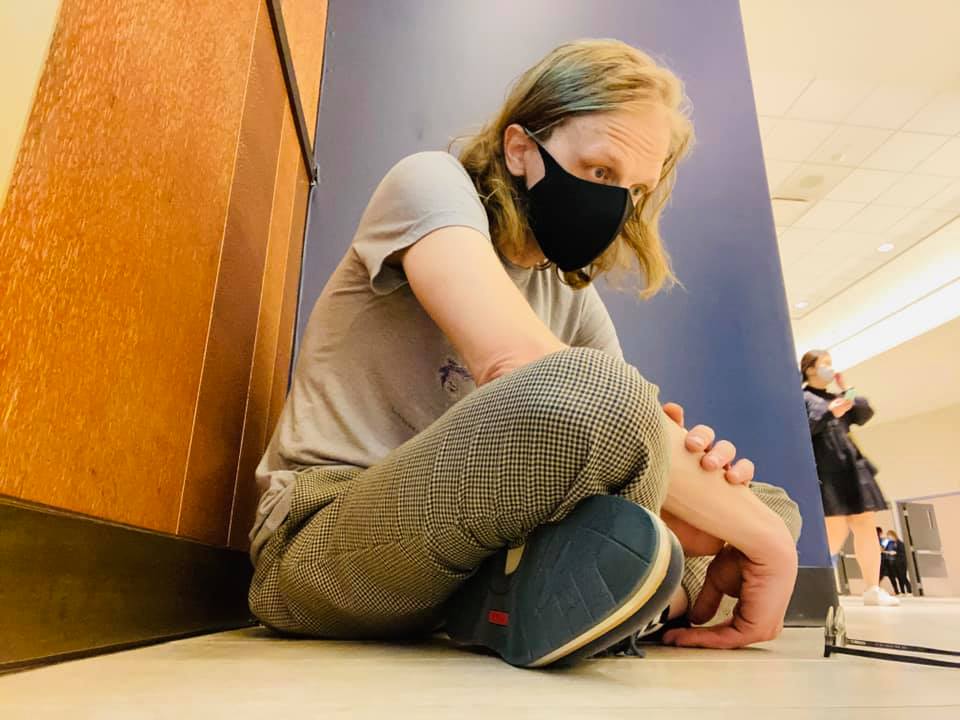
Mr. Wierzba is as rigorously intelligible as an open book and was so as soon as you set eyes on him, his tending to carry himself in a rather regal, yet simultaneously absent-minded fashion. A girl we both knew (!) said she thought he betrayed the impression of being wrapped like a gas station tuna sandwich in a sort of mysteriously wealthy clown wrap, or perhaps a drunken aristocrat cloak. One way or the other, it is safe to say that Wierzba is incapable of moving through an urban setting/environment without causing something of a mass panic, eyes violently collating his every baroque movement, children being shielded from his wobbly approach, folks changing their course to avoid the inevitable altercation with him. These responses, as well as many others cast under a similar aspect tend to follow Philip Wierzba like a catamaran plague. However, on the day in question, he was in the part of town where nobody seems to pay him any notice, perhaps explaining certain underlying reasons for his having chosen it as a place to live shortly thereafter. He was drifting furtively through the dusk totally unnoticed by anybody excepting small dogs and the odd child. (Odd, to be sure!) Even those who periodically would pass him on their way(s) home from a friend’s or whatever or rushing off to some place of debauchery, say, would not bother to turn their gaze toward Wierzba. And those who would quickly feast their lifeless eyes upon the towering cuss would not expend the energy necessary to dwell upon either the beheld or the beholding. Philip Wierzba felt as free as he ever had in his whole life. I know this because it says so in one of his journal entries, which I have splayed open across my oak writing desk at this very moment. Here is an image of him camped outside the Apple Store, gearing up for that saviour hour...
At the exact same time that Philip Wierzba was discovering freedom, I was reading the Friday paper (it was Sunday), alone in a discreet booth at the back of Sam’s. Wierzba's choice, not mine. I was waiting for my mysterious guest to materialize. In truth, I had chosen the booth at the back so that I could drink from my flask of Scotch undetected. I would be deceitful if I said that I was not a little nervous about the meeting. I had never met Wierzba and had only talked to him briefly on the telephone two days previous. He had called my office desperately demanding to speak to me, this pro-pulsed by an apparent recommendation from a close friend; my secretary had repeatedly insisted that I was too busy to talk, but apparently he was rather obstinate, a claim which I was soon to validate through my relations with him. He could not be deterred. My secretary—I think it would have been "Damn it" Janet Turner at the time, an all together pleasant woman—was eventually forced to relent, pro-pelled to total mental exhaustion at the hands of the painfully insistent churl on the other end of the line. She handed the wireless telephone to me with a look of dismay and a quick semi-coherent apology as she rapidly scuttled back out to her desk. My first impression upon speaking to Mr. Wierzba was that he was totally, stark-raving mad. I am not sure if this impression originated from what he said or the manner with which he said it, both of which were rather immediate in their peculiarity. Definitely, though, this was my impression. His voice possessed a bohemian, mock-professional/professorial inflection of the kind one would tend to associate with young, absurdly contrived hipsters. However, this quality was offset by his immediate and clock-regular proneness to flights of half-lucid fancy. For example, a brief explanation as to how he had come into possession of my office phone number quickly evolved into a treatise on dwindling privacy in the late 20th century, which in turn shifted his interest to some friend of his who had, in the early 1970s, been under constant surveillance by at least five prominent world governments. ("Not to mention free-lancers," I recall him adding.) I retain a vivid memory of having become very interested in this strange voice rather immediately. Many of my colleagues in the legal business, I can imagine, would heave most likely, after concocting some vague excuse and dispatching some necessary pleasantries, hung up on Philip Wierzba without the slightest hesitation. Something held me there. Something prevented me from putting down the receiver or fabricating some quick lie about a meeting. It was not so much that I had nothing better to do. I was actually rather busy, I recall! It was simply a case of my having become unwittingly interested in this man on the phone. I was ready to entertain what he had to say. He, I figure in retrospect, totally sensed this...

As I was taking a hit of Scotch in the back of the diner. I am sure. I am sure. I am surely sure, sir, that all of this information was filtering through me. I must admit, sir, sure, that my recollection on the...the matter is...hazy. Sure. Surely. Both in lieu of the slow... stinting effects of the Scotch and because of some anxious residue retained from an earlier argument with Lydia. Oh, fuck me. One of all too many that day, that week. This series of arguments had been surrounding and covering [combat through grey sheets and streets] my penchant for periodically not calling her or coming into contact with her for exceedingly long periods of time. I felt her to be overreacting, mostly because we had only been seeing each other for a very brief interval and because I did not feel that I had been avoiding her. I chalked up her irritation and tension to the fact that she had recently, for baseline economic reasons, been forced into taking up a job as a counter-girl at a doughnut joint whilst I held the comparatively superior position of lawyer.

At any rate, one thing I recall quite vividly about that early evening at Sam K’s was the particular urban squalor of this unusual place. I wondered at Wierzba’s potential motivations for having chosen it as a place ideal for his specified form of legal consultation. I cannot remember the waitress, and, of course, there must have been one, but I do remember that the only other two people in the place were drinking coffee alone. A middle aged woman, with her face caked in many-day-old makeup and the rest of her cocooned in an almost tangible aura of despair, was sitting up at the bar. (As this was/is a "diner," I suppose you cannot really call it a bar.) She looked like an old, diluted prostitute making the best of a still intact, but fleeting, lucidity. Looking at her, I remember being flooded with a sort of melancholic grey of sheet street. She made me feel sad, uncomfortable, and ridiculously alien. On at least one occasion, the image of her, sullen and detached, pushed me to the verge of abandoning the diner and consequently of aborting my imminent meeting with the strange and insistent Philip Wierzba. She turned to focus outside the diner with an expression that appeared as if to be fixed on the dissolving ghost of a long-gone lover, suspended in the atmosphere before her, and it was nearly more than I could take. She held a violent air of division. She was the Living God Twitter its pre-incarnate and incarnate and post-incarnate self. She was drinking straight from the moat surrounding the Tower of Living Babel. There was also a man sitting in the furthest booth away from me, next to a primitive and I suspect long-since-defective jukebox. If not for periodic spasms in his left shoulder that would trickle with seismic accession down his aging arm, I would have taken him for dead. I only saw him sip from his coffee cup on one, fiercely laboured occasion. He wore a tattered old Expo’s cap and a thinning shot-to-shit tweed. I was too half-drunkenly terrified to look him in the eyes. This seemed no place for me to be in my present condition. 

Despite the fact that I had been carefully analyzing the street through the large front window, I did not see Philip Wierzba until he came sweeping through the second set of diner doors. He entered like a figure in total, perhaps self-mocking control of its surroundings. I knew immediately that this was my man.


He carried an energy with him. And a sweetness. It conveyed itself in his face, his countenance, every aspect of his aspect, and in his movement too. It had been in his voice two days earlier. I had felt it even over the phone, a sense of clarity and drive. There was a causal purity to him. He approached my table with a strangely clandestine lack of eye contact. It was as if he were trying to avoid having our meeting seem anything more than entirely routine. I could not imagine who he might think would be watching us, but I played along anyway, maintaining a drunken disassociation. First setting his large envelope down on the empty table, he silently lowered his wiry body into the seat directly across from me. His mind still seemed to be wandering off elsewhere and he did not speak. I was half glancing at the envelope and half summing up his physical appearance. To this day I cannot understand why his manner and dress did not alarm me; I have already described both, and thinking back on that moment it strikes me curious that these have not been more thoroughly analyzed for clues. I have no real explanation whatsoever. What at all even is this lack of prurience on my part? Suffice it to say that I was not myself that day and that my faculties of judgment were rather bleary. After a minute of silence he furtively shifted his gaze toward me and, immediately comprehensively summating, spoke to me for the first time. His voice crackled and broke. Any trouble finding the place? he asked dryly, with limpid disinterest. Not really, I responded. Good … good. He ran his hand slowly across the envelope that he had placed on the table. Let's get down to business. By all means. After my having said this, Wierzba seemed to drift back off into his own endless thoughts. Then, without anything resembling a preliminary flurry, his face jerked as if awoken from an ongoing, infiltrating dream or perhaps a local anesthetic. Over the periodic surfacing of which he held no authoritative control whatsoever. I … I have a small …  a small proposition for you … so to speak. His voice  trailing in and out and crackling staticky also. His eyes darted about defensively. I was startled that he would talk in such a fashion. A client had never come to me before with 'a proposition.’ The term suggested to me a partnership as opposed to a normal client/lawyer association. It also kind of scans underworld. Such unfamiliar, and perhaps suspicious terminology made me somewhat uncomfortable. Despite this I politely asked him if he wanted Scotch, which he did not, and then encouraged him to pitch me. To put it simply: Do you think I could get a drink of that? He was pointing at my flask. Wait, what?..you just... He merely kept pointing at the flask as I trailed off. I reached across the table and handed it to him. Go crazy. He smiled and drank. I have been doing some rather significant work of late. Dangerous work. And I'm looking for intelligent men in the legal world to do some work for me. Well, not so much work as much as, well .. I am looking for some very easy assistance. He looked down again at the envelope. I am looking for reliable men to hold onto certain…certain unguarded documents. These documents have come upon my person, I must admit, rather…well, rather illegally, but you must understand that my possession of them is necessary. Someone must bring these things to light and it seems, well, let us just say that it appears that I have been chosen.

Chosen for what? 
I asked curtly.

Well, since you ask. The way I see it is that it is up to me and it is my responsibility to blow a hole straight through certain acts of…let us say corrupted acts and actors. He accompanied this remark with a very peculiar system of interconnected hand gestures. Certain people seem to think that they are impervious to the general tenants of quote-unquote "democratic political practice" and that they can get away with whatever they want. It is my intention and the intention of my trust to, well, you know, teach them otherwise. He finished the contents of and passed my flask back to me. His eyes settled into a strange indolence. I sat back and hit the Scotch. But there wasn't any. 

Look I don’t know who told you about me, I said taking another lazy hit off nothing, but I am afraid I must tell you that I’m a small-time insurance lawyer. I’ve never stolen anything of any greater value than an O Henry bar, which I’ll have you know made me feel so bad that I went back to the store, crying, and returned it to the cashier…I was ten. 

Philip Wierzba looked at me confusedly. 

I’m not James Bond, I added, after a moment’s deliberation.


Saturday, September 4, 2021

On Irony 2021: An Erotic Fiction

  1. He says, “I grasp your thoughts well in advance of your becoming so-to-speak aware of them.” He that says is the young, chestnut-haired student fishing coins out of his jeans. He that says is tipping the cab driver. 1998, Ottawa.
  2. She undoes her red hair. Shoulder and street lights. She stands next to the cab in the early morning breeze of late summer. She issues a concerned expression with her painted mouth and picks nervously at a crease in her black, strapless dress.
  3. He says that there is no reason to be alarmed. He pulls a pack of Camels out of his tattered blazer. He says, “I am a peaceful oracle…I would never use your thoughts against you. Besides, you are a veritable innocent…you have nothing to be ashamed of…”
  4. He has that boy grin. She has that matronly concern.
  5. She says, “Do you mean to say that you have been listening to my thoughts since I approached you and your friends in the bar? Do you mean to tell me that you are a psychic and that neither you nor your friends sought to warn me of this highly pertinent, and perhaps disturbing information, in advance of your, shall we say…landing me?” The laugh that follows is an uneasy laugh.
  6. He says he is no psychic, cupping her slight hands in his darkened palms.
  7. The cab pulls away from the curb and disappears.
  8. He and she are doing different kinds of physical touching as they walk.
  9. Chrome door at the back of the house where she unlocks the myriad rusting latches with a key eventually scrounged up, after much insidious shuffling of bills and crumpled receipts, from the lower depths of her snakeskin purse. Showing him up the dank wooden staircase to her father’s attic.
  10. She says, “This is my room.”
  11. He smiles and moves up three steps in order to kiss her for a long moment in the doorway.
  12. The room is painted dark purple and its doors, oval window, and picture frames are all trimmed black. At one end of the room there is a small kitchenette with a stove, oven, sink, miniature refrigerator, and stacks of black milk crates. At the other end sits a small futon mattress surrounded by candles. Anaïs Nin, Byron, Shelly, Wordsworth, futurist Russian poetry, and large harcover anthologies, as well as numerous Penguin paperbacks and a picture of the young woman’s family feeding ducks in the rain by a large Canadian lake. In the photo the young woman, who is twenty-six years of age at present (1998, Ottawa), appears to be no more than seven. Gaudy Christmas lights are stapled to the walls and appear to be the only potential source of light other than the candles. Whatever available light there is reveals prints of all the famous paintings, such as Nightwatch and The Kiss, the amassed roughage hung randomly on the dark and somber walls as if flung there—
  13. She places a record on the phonograph.
  14. "I positively loathe all manner of modern music," he deadpans, and she shoots him a perturbed look. She has put on Bauhaus.
  15. “What about the Moonlight Sonata?” she asks, maybe disingenuously and definitely distantly.
  16. He says, “No, no, Mozart gives me anxiety. I can’t listen to him when I am drunk.” She has a swing in sentiment. They cozy up for a bit.
  17. Giggling strangely, she goes to the stove to boil water, and he walks over to the phonograph, grabbing a different Bauhaus record from the top of the pile and dropping it onto the player. The record begins to spin and the student slowly lowers the needle into the black grooves at the very edge of the acetate.
  18. She asks him if he is really an oracle.
  19. He begins to flip the rpm switch on the phonograph back and forth so that the music plays at the right pace one second and speeds up comically the next. Naturally, she asks him what he’s doing.
  20. He says, "I’m becoming…I’m becoming part of the creative process. If you give me some wine I promise I will tell you everything. In all truth, I generally do only drink red wine, but this, I am sure, will be just fine for now. Okay, I will tell you everything, but first you must promise to listen to everything I have to say and then wait until I am finished before you respond. Like, okay. When I told you that I was an oracle and that I had been reading your mind, as you may recall, you had just finished telling me about your male friend with whom you were supposed to have some celebratory drinks tonight, what with it being your birthday and whatnot, and you complained about his insensitivity and about the horror you felt at his not showing up. You told me over and over, all night in fact, whether you were aware of doing so or not, that you were repulsed because nobody has ever been so cruel as to have ever subjected you to rejection so…abjectly. In such a…a birthday-like situation. I sensed that you loathe solitude more than any other fated thing and this is why you project a guise of individuality and a self-reliance. It is a mask you wear in order to hide your real face which fears, more than any thing else, abandonment. This was only emphasized by the way that you spoke of your fellow employees at the department store, who make you self-conscious and bitter precisely because they are so friendly to you. Yes, but they are stupid and insensitive, sure, but you still need them to like you, don’t you? Yes. Complete and utter abandonment. Also you spoke a great deal, roundaboutly mind, of your love for your father and your contempt for your mother, thus, unwittingly, drawing attention constantly to a conceptual placement of your ego-self within a quintessential embarrassing triad. Now, the whole effect of my feigning being an oracle, blessed with a kind of gift of clairvoyance, was intended to be one of fissure. It was hoped that by opening our gradual discourse of mutual codes to a real psychic, electromagnetically phenomenological framework, the Oedipal triad would be torn asunder by its own dunderheaded and hugely stubborn impracticality. You understand? What purpose does repression maintain in the face of clairvoyance? You would no longer feel a need to authenticate your guise through these boring reminiscences or whatever, while simultaneously offering yourself to me so openly. I mean, right? The systematic placement of your parents on opposite poles of a psychic tug-of-war! It was hoped that you would espy no longer value in suppressing your more authentic proscriptive codes beneath the inauthentic centralized defences. All that about the human mechanism which is plastic, false, pretence. You understand? I was not interested in seeing the scars of your socialization! I hoped you would see that I, being a psychic oracle, could easily see through the pretence of subjecthood that you so fiercely present, its reification utterly fatuous. I was addressing a series of codes under the pretence of making conversation. It did not matter whether you believed whether I was an oracle or not, nor even whether I could actually read your thoughts. Just by processing the codes that I presented you were forced to apprehend your environment and the consequent goings on between us from a more open perspective. I was trying to do you a favour, I think. I was trying to do us a favour, babe. Repression is the enemy. I was saddened to see you so painfully repress your fear of abandonment. Whether you see it or not, I am actually even doing you a favour just by coming home with you. I am placing a much-needed break in the cycle. Are you beginning to understand?"
  21. She feels bullied and says so. But she commits internally to retaining some good humour in the face of it all.
  22. He says, “I know, I know. You see how easily I get sidetracked? I like this wine. You see, although all you folks are right to trace the genealogy of irony as a modal apparatus first and foremost back to Socrates and then Kierkegaard, like history were merely dominoes of some shit, I have problems with them. Particularly with Kierkegaard. You see, Kierkegaard is correct in assuming that irony enables a removed condition of spectatorship over the goings on of human life, but he is, I believe, specious in his directing irony away from play and into a further avocation of grounds for religious faith. You, being a student of literature, must be familiar with Derrida’s concept of play within the realm of theory. Play is the result of our being cognizant of our inability to ascertain our ends, our finitude. Have you read Speech and Phenomenon? No matter. You can see it in Foucault as well, and I know you’ve read Foucault. He has his theory of the paradox of origin, paradox, of course, being fundamental to Kierkegaard’s notion of irony. The Order of Things I think, which states that while the question of origin always returns to us, bearing the pressing voice of necessity, our capacity to retrieve it is ever slipping away. We are caught in a vortex of fundamental paradoxes which underpin even the first instance of the newborn’s perception. We are always staring the impossibility…the impossibility of our ends…staring them…in the face. You see? This can be expanded to a point where we realize the impossibility of our imagining, since we are cognizant beings and thus endless processors of code, the possibility of our own death. And beneath these fundamental paradoxes lie a parade of miniature equivalents which decorate all of our moments of connection whether analytic, and thus basically objective, or synthetic, and therefore not, or not really. Everywhere we look we see contradiction in the gaze and the contradiction or impasse inherent to the gaze itself. There is no order beyond that which we impose. Or, I suppose, allow to be imposed. Thus, the lifeworld opens up to two different modes of play: imposition and performance. Imposition upon the horizon and performance our coming to be revealed…brought to the world…because, you see, we are flung here quite randomly. This is the manner of irony I present to those who are fortunate enough to come into contact with me. I am always shifting my relations to objects, people, texts, and ideas while simultaneously searching for new performative idealities in and of myself. Language is the most direct vein into this manner of irony and that is why my favourite ironist of all time, and the one most influential on me personally, is Groucho Marx. Yes, very much so. And it is just this manner of play that manages to save us from the anxiety that Heidegger warns us of and the despair of which Kierkegarrd speaks. Despair, as a totalizing process, is displaced along with the centralized configurations of self which are deemed necessary by the stupid in order to provide a semblance of…of continuity in…their…lives. I mean, after so much time, have we learned nothing from Nietzsche? Should we not be constantly revising ourselves through unconscious machines of desire? As I see it we all of us would be better off as an army of Groucho Marxs using language and cultural forms as a diving board into the absurd. We ought to all ask for tea we have no intent of…imbibing. Always building prisons around ourselves and escaping from them with the next gesture. Always shedding our performative skins. There is no despair in a mind that wanders conditionally. If the prison is new, and I posit this loaded term prison as no mere metaphor but rather as an anatomical mimesis of selfhood, the centre or the…the looking out upon...then so too is the ground or horizon to which it is fastened. With a new ground comes the abolition of old scars, do you understand? The great…
  23. She says, “Wow.” She has bee sipping meditatively from her small teacup. She says, “I can see that you have given this much thought.” She had, however, physically gotten up about halfway through the tirade.
  24. He reclines on the futon mattress and begins to undress himself with his left hand, starting with the blazer, working through the vest and dress shirt, and ending with the jeans, clutching, the whole time, a volume of Anaïs Nin's letters in his free hand.
  25. He proposes they take a shower and she walks him through the complications that would appear to decisively forestall any such recourse.
  26. He says, “I only told you that I made that psychic oracle business up in order to move onto the topic of irony without first having to tie up any loose ends concerning my powers as an oracle. It so happens, in all actual fact, that I am honestly psychic, as are those appalling friends of mine with whom I was seated at the bar when you met me.”
  27. She says, “Fine, fine, I believe you.”
  28. He that says throws away the book which he has held the whole while in his right hand and it makes a thump on the floor as it lands unseen to he and she who stare at one another still, as if dancing cobras in a charmer’s trance. She laughs again, more genuinely this time, and puts her mouth to his. They kiss passionately as she runs a hand up and down the ladder of vertebrae at the top of his spine. He rubs the small of her back with one hand and cups her cheek softly with the other. After a moment they fall back into the mattress, he arched rigidly above her, holding himself up with one hand and now clumsily working off his underpants with the other. They kiss some more as she clasps his buttocks and begins to pant loudly. Her head snaps back and he kisses her throat and the nape of her neck with his probing tongue. He says, “If I were going to take a man’s breath away, to kill him, I would hit him here with all of my strength.” He kisses her there, much more forcibly than before. She shuts her eyes tight and sighs deeply, teeth clenched together and lips slightly parted in a kind of rabbit smile. He says, “But you I could never hurt.” With a free hand she slides off her panties and grabs hold of his erect penis. He arches his back and collapses next to her on the mattress. She verbally commands that he enter her. He says nothing, but rapidly goes to work. He sits up, for a time, with his arms anchored behind him. She drapes her arms around his neck and sticks her tongue in his mouth. They make love in this position until his arms begin to tire and he resorts to flipping her over, thereafter mounting her from behind. She pants deeply for a moment, throwing her head back, until she suddenly freezes. She says that she wants to be able to see him. He pulls out, letting her roll over, having proven unable to turn her over and remain inside of her simultaneously, then renters from on top, cradling her in his arms. She moans heavily, already reaching orgasm. He increases the intensity of his thrusts until her body seizes in ecstasy, her insides convulsing. Oh my God, et cetera. She rests her head on a pillow, struggling to hold her breath. Stasis is all shattered all about. He rolls half over to her side, resting on his elbow, and continues to make love to her with slow, gentle thrusts. She lies motionless but issues sighs of pleasure, bending her neck with tense resignation as he works his left hand under her brazier and languidly massages her breasts. She is also stimulating herself. This goes on for some time. Eventually she begins to reach orgasm for a second time. This time, however, instead of moaning passionately, she emits a static noise that resonates tremendously. She can take no more, hollering like a lunatic, fully overcome by the orgasm, letting go of everything and falling back against the mattress with her eyes shut.
  29. She asks him if he has cum. He that says says, “I’m an ironist; I never cum—” 


Thursday, September 2, 2021

Out of Body & Co.

Chris, a heterosexual man (nominally), had said that he has come to realize that the secret to non-derailing casual sex is being able to lock-in on all the nymphomaniacs in your city, town, or region, and that it will have been this capability or capacity that will ultimately have shown algorithms and silicon-based intelligent creatures to have earned their bread and butter, right there in the veritable foyer of Paradiso. My position is that if you go all shoe leather, bust clouds and pound pavement, collecting the stories of the guys and the gals and the +++, ain’t nothing in it for you but grievance and a whole real straight-up freakish array in all that prismatic refraction. I meet anybody, first thing I ask: not ‘is this trouble?’; rather: ‘what in sam hell kind of trouble are you, honey? Enlighten me…’      

I am not sitting across from Chris, but rather his cousin, my efforts to get to know whom actively or retroactively the instantiating tripple-trip pratfall that landed me with Chris, my downfall. The cousin is mincing words and forking at his salad. This is not somebody I ought to have attempted to endear myself to under any circumstances. That’s okay. The world is a happy idiot fish fry or it is a thirteen hour tragedy in which you get your eyes poked out by trick hands. Look into my eyes, Mr. Cousin. I got Chris whacked. Oh, you’ve got something on the corner of your mouth there!
The bitter tears of Chris.
Ottessa Moshfegh, Death in Her Hands: “But there was no body. No bloodstain. No tangle of hair caught on the coarse fallen branches, no red wool scarf damp with morning dew festooned across the bushes. There was just the note on the ground, rustling at my feet in the soft May wind. I happened upon it in my dawn walk through the birch woods with my dog, Charlie.”

My mother was a pitcher for the Mariners. Or so the saying goes. Claudius is in the commissary, or at least that’s where I last saw him. He read Graves in the Nordic North. Claudius—who is an oversexed seaman and frightening—believes that the only real law of the land is that a barking dog never bites.


Ottessa Moshfegh, Death in Her Hands: “If there was anything I’d learned from Agatha Christie, it was that oftentimes the guilty party is lurking just underneath one’s nose.”

Voodoo, Carolina. We are here for gettin' reconnoitered in 'em darnkess body suits...


Gary Indiana, from his savage-as-hell novel Depraved Indifference: “Warren needs to sign some property over to a friend. That friend would sign a quit claim so the property has to go back to Warren next time it changes hands, at some point in the future when we’re not facing a judgement.”


AT SOME POINT IN THE FUTURE. WHEN WE'RE NOT FACING JUDGMENT. DIG?


And then later, in the same novel, page 133: “Echoes of Mavis, memories of Mavis, scattered bits and pieces of Mavis had wafted through all of Warren’s subsequent experience of Carnal Love, and now Mavis loomed, like a fata morgana, on the discernible horizon of his immanent Personagehood, his arrival as a public figure—as if Mavis herself, like the arctic williwaw, were steadily blowing him towards his destiny.”


The Lady ICE: ai in my body. The scariest thing about your phone is that is should be listening to you…in order to be a properly good phone. Your phone needs to know its stuff. 


Chris sends his warmest regards. Say hi to your phone for me.


Thursday, August 26, 2021

THE ILLUSORY NOTHING

 Samuel Beckett, "Texts for Nothing”: “Who are these people anyway? Did they follow me up here, go before me, come with me? I am down in the hole the centuries have dug, centuries of filthy weather, flat on my face on the dark earth sodden with creeping saffron waters it slowly drinks.”


Antione Volodine, fairly late in his 2014 Prix Médicis-winning stunner Radiant Terminus (once somebody has had a go at Anglicizing it): “The fuel rods had united. They tried to rejoin the core that had taken up residence at the bottom of the well the Gramma Udgul guarded like a dragon over its treasure.” 


PSYCHO-PERSONA

Some people don't like the film scholar, historian, and I guess, uh, aesthetical topologist (?) David Bordwell, but I do, and here's why: nobody wants to get elaborate about anything anymore because they are afraid they will look like they didn't study for the test. David Bordwell will show you thirty-six stills from two or three Yasujirō Ozu movies in a commendable effort to explain a certain kind of camera or cutting 'operation' Yasujirō Ozu can't seem to stop trying to perfect. I love David Bordwell, but so often in university I had to explain why I disagreed with him on one subject or another before I could proceed, which I found discouraging and stupid. In his essay "Art Cinema Narration," Davey Boy goes way fastidious with the subject. How do we do aesthetics and film form? Inventory, of course. One thing Bordwell believes is that "art is more complex than life can ever be," but then it becomes as though he forgets that movies are made in and about life. At this point somebody usually says I don't have a paying gig anymore. Heh heh. Academia didn't have a chance. I had completely forgotten where I had placed Academia.

How do we do structure and form in image + sound + floodlit time?

Jean-Luc Godard: "And something that is astonishing with Hitchcock is that you don't remember what the story of Notorious is, or why Janet Leigh is going to the Bates motel. You remember one pair of spectacles or a windmill..." 

Jean-Luc is not addressing me, because if he was addressing me he'd be quite wrong—of this there can be absolutely no doubt; I know these films too well—though it does seem credible that he is speaking to somebody way in the future and that this person does respond in this way when these two movies are evoked. If that's not true, you can turn it into some kind of placeholder and put it somewhere else and run it better so that it is true or close to true. Whatever.


All that aside, the main thing about Hitch is he puts an invisible cursor down over the action and drags the audience along like a puppy.

Well, cinematic modernism has a lot in common with literary modernism, which I insist on insisting shouldn't be too surprising, and you obviously know this if you've seen Persona or Last Year At Marienbad, each of which start throwing "objective realist" conventions out the window immediately, like maybe you'd walked in late or started with the wrong reel. However, if we were to suggest that "classical fluidity" is missing we need to very clear by "classical" we mean something approximately like the first half of the 20th century. If you believe your great grandmother has an experience of movies comparable, really, in any way to your own, you are sorely mistaken. Disjointed, confused? Tell me about it. But, look, word on the street is that there is a whole lot of different disjointed and confuseds out there.  

BUT I REALLY LOVE HITCH'S CURSOR!

David Bordwell gives a hint. Graphic counterpoint or temporally separated shots-reverse-shots between Marion/The-Cop-Who-Pulls-Her-Over & later ones with Norman/Arbogast help establish that, under heavy pressure & riddled with riddles, you can literally drag the audience's identification like a computer's mouse might, dropping (from) Marion, who has been murdered in the shower, and landing on Norman, who must VERY DESPERATELY burry the deed. Audience members who follow this pivot, bouncing off the shower more or less unscathed because "it's just a story"...have just been rooked...

]


OTTESSA MOSHFEGH, DEATH IN HER HANDS

I threw the notebook in the trash, along with all his other papers, then wished, 

when the trash got picked up, that I had burned it all instead, had the nerve to burn the 

whole house down and scatter the chalky ashes in an open sewer grate somewhere,

let all of Walter's thoughts seep into the urine and feces that must still exist somewhere in

the bowels of this messy earth. 


2.,

Persona relies on an effect-affect curiosity of relations, or a perplexity of them. Alma and Elizabeth are increasingly of one another just as they increasingly careeningly blast up. What is going on here and why? Traditionally, nobody has had a goddamn clue. However, in the case of this film and its particular space-time: evidently it very often has not and continues to not bother them. Purely on account of the aesthetics and the kinky stuff. That's my take.


Saturday, August 21, 2021

Jason's Y2K Deleuze: Redux


0.1. Gilles Deleuze was fond of Nietzsche’s Philosophical Hammer. In a basic sort of a way, Nietzsche suggests—or is retroactively assisted to that end
—that the Critical Philosopher will look at a hammer and quickly realize that it has two ends which perform different kinds of task:1) bang end for banging nails; 2) pull end for pulling nails. Even in philosophy, it is too often the case that idiots run about frantically thinking you are just supposed to be hitting things with this or that hammer.

0.2. Little children always map-out a provisional ‘field’ better than your on-the-clock architect ever will. We become simpletons thanks primarily to institutionalized ('habituated') learning.

0.3. Self-explanatory title of André Pierre Colombat’s essay “Deleuze and the Three Powers of Literature and Philosophy: To Demystify, To Experiment, To Create.” 


0.4. It is style in and of itself that contains a mode of life unique to it.


0.5. A model for music of the spheres: heterocosms of difference and multiplicity.


0.6. Imagine for a second that it's acceptable to speak about something kind of like a Genealogy of All Lived Experience. Many philosophers—most especially Heidegger & Wittgenstein, in very different ways—have insisted that it is egregious to pretend we can do this. Toss such quibbles aside for the moment. It is through his close—perverted, he says—studies of Spinoza and Nietzsche, that Deleuze first really starts making central philosophical problems those which seem pretty unambiguously to relate to how collectivities of people have, throughout 'recorded history,' tried to organize and negotiate their (contingent) personal affairs in the context of broader worldly ones. This hardly comprises the Deleuzian project in its totality; but to ignore this crucial business altogether would be to exercise bad faith. It is not for nothing that Gilles Deleuze and Félix Guattari will ultimately go on in their famous two part study on Capitalism and Schizophrenia, to declare Schizophrenia the Process of Life.  


1.1. Deleuze on Spinoza: "Before Nietzsche, he denounces all the falsifications of life, all the values in the name of which we disparage life" (PP, 26).

1.2. Living is always a lot of untangling prejudices before you can access tasty things. This is ideally the case even when one is living high on the hog. If you have no idea what I'm talking about, you're already in serious trouble.

1.3. Spinoza sees most men using reason in order to offend reason most egregiously. Spinoza decries all tendencies to look for arbitrators or things/creatures in abstract conceptual non-spaces when everything is just nature doing nature all the livelong day. Spinoza puts himself in a position to be declared a heretic, and he only deepens his own radical crisis by addressing these possible charges early and often. He writes (in the 17th century!): "there have arisen prejudices concerning good and bad, merit and wrongdoing, praise and blame, order and confusion, beauty and ugliness, and other things of this kind" (Ethics, 31). For all his fancy footwork, again and again Spinoza makes clear that he's having none of it.      


1.4. People don't need to make the world intelligible in order to possess Greater Truth, but rather as a condition and project for living. If people don't like doubt, they show us an insecure hand pretty damn nakedly.


1.5. Because they know they are driven by drives and pulsed by impulses, Spinoza believes his contemporaries are dishonest with their bodies and, in fact, with all extended substance. Part of what appears to drive people is the need to not hear anything inconvenient. Doubt is an enemy to most people and when they are scared of their enemy they will demonstrate that fear by reasserting all the more aggressively the (conveniently simple) abstract model. The drives and impulses must come from a Intentional Divine Will that is Good, or the frightened person will not stop being frightened. In Practical Philosophy, Deleuze reminds us of Proposition XXXII from the "Concerning God" section of Spinoza's Ethics: "Will can only be a necessary cause not a free one" (Ethics, 26). Simple people view things with simple and reasonable end results in mind. This is why they assume that material effects in the world and even the whole of nature conform to the designs of an intentional intelligence: they "are satisfied, for then they have no cause of further doubt" (Ethics, 32).


1.6. If God were an intentional deity, why then all the hardship and calamity? Simple and very foolish people have traditionally had to make themselves believe these are mysterious punishments for known or unknown indiscretions. This is the modular opposite of the right path. Nietzsche will later call it 'reactive nihilism.'


1.7. Nature cannot have any fixed ends and is conditionally infinite. Spinoza: "Infinite things in infinite ways (that is, all things which can fall under an infinite intellect) must necessarily follow from the necessity of the divine nature" (Ethics, 16). God must be defined, as Deleuze and Guattari will go on to say, as omnitudo realitatas (the whole of the real, the Oneness of Infinite Substance). Now you can start actually having intelligibility. Man's greatest crime against reason is merely the habitual mistaking of an effect for a cause.   


1.8. You are not going to like this, but suffering is not negative, it is positive, just like ecstasy. The body only knows protons.


1.9. Deleuze: "There is, then, a philosophy of 'life' in Spinoza; it consists precisely in denouncing all that separates us from life, all the transcendental values that are turned against life, these values that are attached to the conditions and illusions of consciousness. Life is poisoned by the categories of Good and Evil, of blame and merit, of sin and redemption" (PP, 26).


1.10. There ends up being three tridents of Spinozist critique: 1) critique of consciousness; 2) critique of higher values; and 3) critique of the "sad passions."  We have thoughts, and maybe even a great many distinct categories of kinds of thoughts, but we do not have "consciousness" per se. We have bodies, and yet we have only begun to learn what they are capable of doing.    


1.11. Infinite possibilities or realities for mode and attribute within a unified infinite substance ("absolutely infinite"). 


1.12. Consciousness is enslaved by illusions (illusions of "finality" or "freedom" or "Theological Illusion" (PP, 19)).   


1.13. What is needed is not the blind authority (or governance) of illusions, naturally, but rather a rescuing of mind and intellection from subservience...as well as the repositioning of the work of mentality around an immanent/natural plane of effects. Thoughts only have positive information value, not truth value, but that 'positive information value' is still very much ACTIVE VALUE, ACTING.


1.14. Deleuze attributes to Spinoza the drawing of a fundamental and crucial distinction between good and bad (affinity/value) as opposed to good and evil (moral determination). Obviously this is thematic material Deleuze cannot help but also touch upon in his famous study of Nietzsche (written before Spinoza: Practical Philosophy). Negotiated and/or critically contested values become the Loadstar of a Philosophy of Life; Lived Experience is the Best Teacher— 


2.1. Friedrich Nietzsche is a very bad and scary man. In "From Ressentiment to Bad Conscience," the fourth chapter of his legendary 1962 book (or extended monograph) Nietzsche and Philosophy, our resident commentator would have his moustachioed German predecessor wholesale condemning anybody, it would seem, impudent enough to share the planet with him. Although...let's wait a second, and not so fast. Who or what earned this beastly rhetorician's most scalding ire? The reactive man and the nihilist. These are Brother Friedrich's sworn enemies. It is the reactive man and the nihilist who uphold prejudice, higher values, sad passions, and dialectic. A climax is or will be (or eternally will be, repetitively) arriving in the form of the last man, the most miserable sub-toll-bridge troll-person: pure domesticated, passive sufferer; a wretched and debased creature.


2.2. Active forces are forces that are able to act. To be able to act is to be able to do what you are capable of. The master is a master simply because he is in a position to act his reactions. In him, forces are made active because he can externalize them without much threat of penalty. If reactive forces are to stay dormant, and thus remain reactive, "reaction ceases to be something acted and becomes something felt (senti)" (NP, 111). The reactive mind has its own more active and more reactive dimensions. Mnemonic imprints form lasting impressions. Reactive forces get hung up on imprints and their traces (as though the whole thicket were tangled fishing line). The energy of the unconscious of thought itself is a terrible frothing vacuum-like caterwaul of impulsive-impulsal demands!! The conscious mind needs order in order to...order. Unfortunately, it becomes a tiresome terminal idiot, over and over, popularly, as a statistical-type median. People become dumber and dumber in order to corral their fear, cordon it off, scrutinize a pathetically tiny piece of it. If you don't fall in line they will become mean and bullish. It's okay, though. They're total idiots. It's pretty funny.


2.3. One active faculty of mind is that of instrumental or 'pragmatic' forgetting. Without this faculty, Deleuze has Nietzsche arguing, we could only ever be presented philosophically with a 'being-in-mind' whose foremost problem would surely have to be never being able to be done with anything. No? "We can finally see in what way reactive forces prevail over active ones: when the trace takes the place of the excitation in the reactive apparatus, reaction itself takes the place of action..." (NP, 114). 


2.4. If Spinoza doesn't think we humans have a general sort of "consciousness," Nietzsche definitely thinks shitty people have a general sort of reactivity complex.


2.5. Nietzsche believes we all have a problem and we'd all be better served by dealing with it effectively. "One cannot get rid of anything, one cannot get over anything, one cannot repel anything—everything hurts. Men and things obtrude too closely; experience strikes one too deeply; memory becomes a festering wound" (NP, 116). It is the cost of over-reaction, it is its own actual economics (double-ledger), and each of us will find ourselves in the red from time to time. Use these lessons to learn; or, alternatively, damn thee to the flies...


2.6. The way out is always through—   


2.7. The reactive man is angry at things proportionate to their direct effect on his body. The Spirit of Revenge mystifies and confounds his memory. Hark! There comes to emerge: the Venomous Spider of Vengeful Memory, spinning its web "on the plane of the subject" (NP, 116). Weakness wants to triumph as weakness.


2.8. The slave is a real goddamn Protestant. Driven by a morality of utility, the slave is the agent of profit, gain, and possessive paranoia. The slave is always accusing. This is the sad passions in all their shades of grey, blue, and white hot. What the slave is really pissed off about is...Life.


2.9. "When would the men of ressentiment achieve the ultimate, subtlest, sublimest triumph of revenge? Undoubtedly if they succeeded in poisoning the conscience of the fortunate with their own misery, with all misery, so that one day the fortunate began to be ashamed of their own good fortune and perhaps said to one another: 'it is disgraceful to be fortunate: there is too much misery!'" (NP, 128).


2.10. Anybody who has passed through roiling trauma into active recovery comes to discover that the question originally posed by the trauma (and subsequently by its imprints) is: okay, now what?


2.11. Nietzsche called "culture" the "species activity of man." Deleuze logically formalizes Nietzsche's roving critiques of culture by way of three more tridents: 1) pre-historic; 2) post-historic; 3) historic. The ground of pre-history is the grounding operation that demands there be a law about having laws. Culture quickly becomes the process of systematizing prejudices for a reactive citizenry. Models and habits. Culture counteracts the active faculty of forgetting. It fields memory. Creditor/debtor relationships come to predominate. Memory becomes the pathological conditionality for making promises and telling lies. Suddenly memory stars plotting and conniving. It does this in and around culture. It does this on the distant outskirts, also. A great lie conditions the condition of all conditions: Injury Caused = Pain Undergone. Culture wants us to believe we are responsible for arbitrary debts and if we balk it consolidates and finds ways to punish us.


2.12. Pleasure is being generated from all the punishment—that's for sure! that's pure economics!—but the reactive man is in debt and doesn't get to enjoy it...not really. It is profoundly cruel! 


2.13. Punishment cannot awaken a feeling of true guilt in the culprit. It can only excite the Spirit of Revenge (NP, 136).       


2.14. "Man's species activity constitutes him as responsible for his reactive forces: responsibility-debt. But the responsibility is only a means of training and selection: it progressively measures the suitability of reactive forces for being acted. The finished product of species activity is not the responsible man himself or the moral man, but the autonomous and supra-moral man, that is to say the one who actively acts his reactive forces and in whom all forces are acted" (NP, 137)


3.1. Nietzsche was too early; he could not see clearly enough the hovering spectre of the schizo/catatonic that he himself became. 


3.2. In 1972's Anti-Oedipus: Capitalism and Schizophrenia, Deleuze and his collaborator—institutional psychiatrist and Jacques Lacan successor-manqué Félix Guattari—trace the development of administrative logics of debt from primitive territorial machines to new binding despotic enterprises (early modernity) with modified infrastructures of alliance and filiation (and punishment, and culture). With respect to the book in question, the process leads up to (without terminating in) deterritorialized and destratified civilizing capitalist machines. You can live both in the city and the hills at one and the same time. Like a guerilla. 


3.3. It was Nietzsche, Deleuze reminded us in his earlier book, who was first to declare himself all names in history. But Nietzsche couldn't properly see beyond the last man; his view was obstructed. History was always the heraldry of triumphant weakness. It made a lot of fuckin' noise. 


3.4. A bad psychotic episode is all the impulses freaking out all at once.


3.5. There is still always a future and it still always asks now what?