Wednesday, October 28, 2020

Open University for the Trans-Armies Database & Future Classics: cinetagmatics_014

Though I have not read Søren Kierkegaard’s 1849 book The Sickness unto Death since I was a teenager, it is the kind of book that is likely to stay with a person, especially the kind of person, myself being an example, who was once upon a time a pubescent male prone to fantasizing about suicide as often as sex. Kierkegaard was a highly unusual sort of ironist, the authorship of many of his most important works attributed to pseudonymous personages, incorporeal emissaries sent into immaterial trenches to file their exhaustive—and very often harrowing—reports. The name signed to The Sickness unto Death is Anti-Climacus, which I am sure you’ll agree is pretty funny. The book is a disquisition on the subject of despair, and though I do not have a copy on hand, I am confident that my recollection is more than halfway adequate when I summarize matters by locating its conception of despair in the problem of the self. We might allow ourselves to overshoot the mark concision-wise and just go ahead and claim that Anti-Climacus argues that there are really two kinds of despair: 1) the despair in the self at the having of a self; and 2) the despair of the balkanized self that insists to the desperate last on its constituting a self. Early in the book, Anti-Climacus does a pretty famous thing. The suggestion is posed that the self is a relation which relates to itself. Okay. Well...sure. However, if this conscious self is its self-relation, the thing and the relating to the thing, then the proper site of the self exists at a supplementary tier, which is to say the consciousness of the relation, the relation that relates to the original relation. It is a perfectly sound formula. The thing is: it’s extremely abstract. Everything I have just written ultimately pertains to ideality and the domain of the transcendental. Not much here of the earth and the glands—of organs and odours or objects organic. Let’s toss aside the pretence of addressing Anti-Climacus and acknowledge that this line of discursive development finds us precisely where Søren Kierkegaard wants us. Kierkegaard takes us to the abstract realm of immaterial or impersonal despair (the impersonal despair of the person who insists on being a person), because he is above all a spiritual philosopher and his conditional irony aspires to venture as far into a vacated and arid transcendental as it can manage before it is ultimately time to take a leap of faith, turning our will and our lives over to God, or, if you prefer, eternity, the open field of fullness and potential, categorically opposed to the pitiful and finite self that clings to its habits and pretences as though they were a life preserver (when in fact they are despair its very self). The relation that relates to the relation is not God. It is very much not the bird of the air nor the lily of the field praised in Christ’s sermon on the mount. It is not even shit (no odour). This is despair. Have you been through the wringer? Really and truly been wrung? Do you suffer from one or another form of brain sickness? Have you done the ring-around with the therapists and psychiatrists? Is the list of medications you have been prescribed over the years a large one? For those of us who answer yes to all these questions and have lived to tell the tale: we might well counter, okay, yes, all well and good, Søren, but my problem is not the transcendental overseeing of the self as a relation with itself; my problem is the central nervous system. Something happened to me just about two years after I got clean and sober. This was in the fall of 2015. I experienced my first major depression in sobriety. It had very little to do with sadness or despond. Yes, the mood is basically a disaster, although it mostly tends to feel like a pronounced absence of mood. Additionally: you are in physical pain, you have zero energy, your digestion is shot, cognition lags, manual dexterity is pitiful, and presiding over all is a generalized experience of ongoing atrophy. In 2015 I didn’t know what had hit me. My psychiatrist gave me a note, and I was able to take a month off work. I sat in the thing and I progressively adjusted. This is the thing, here I am with the thing, and this thing too shall pass. This is what I told myself. As I have subsequently done every fall. September or October, every year since 2015, like clockwork. This may sound incredible to you, but at this point it is basically a cakewalk. I am a low bottom drunk and former drug addict. What do I mean by low bottom? A nightmare you cannot comprehend unless you’ve lived it. People like me, serial alcoholic visitors of emergency rooms, were once thought hopeless. We were consigned to death. Nothing can be done for a poor soul so far gone. So what happens to me in September and/or October every year is eminently livable. As such it is a thing I don’t mind observing. You know, like a journalist, say, sure, but also in the manner the Jewish people observe Passover on the mirror-side of the calendar. Sometimes I reflect. People I have met, people no longer with us, survivors and fatalities both. The first of five treatment centres I went to was in San Clemente, California. Back in 2006. One gentleman staying there walked off the property, rented a hotel room, and proceeded to get drunk. He severed the ulnar arteries in his elbows, had second thoughts, went to the front desk for help, and died on the lobby floor. I think of the young woman in the last psychiatric ward in which I was held. This was in 2009. She had stepped into a cold shower fully clothed and came dripping wet and shivering into the common area, mute, saucer eyes wide with horror. I shan’t ever forget her. Then there is the woman I met in detox in 2013 who told me the story of how she may or may not have stomped a man to death with her heavy boots in Tokyo after he assaulted her on the street. These are my people. This is a lived experience of the world I know intimately. I am not doing well this week, but my bad days now are incomparably preferable to my best days then. I got clean and sober through twelve-step recovery. I am in a position to know that there is actually helpful material in Kierkegaard. My salvation is in fact right here in the living eternal immediately at hand. In his recent book At the Center of All Beauty: Solitude and the Creative Life, Fenton Johnson seeks to understand and to consolidate his own spiritual practices by way of consideration of famous solitaries. He takes a basic precept from Marianne Moore: “the cure for loneliness is solitude.” This is exactly right. One passes through the struggle and suffering of loneliness in order to arrive at the solitude that gives and keeps on giving. Johnson: “The measure in which your solitude is hard is the measure of the reward it offers.” The works of both Emily Dickinson and Eudora Welty bear testament to this, progressively, over the course of their lives. Both Dickinson and Welty pass through longing and arrive at the “fountainhead” of truth. What did Henry David Thoreau discover through silence and solitude at Walden? In his own words: “I have more of God.” Zora Neale Hurston, inventor, so to speak, of her own hybrid religion, came to believe foremost in “the eternal in beauty.” Of the great painter Paul Cézanne, Johnson has this to offer: “I can say he’s crazy—perceiving a soul in a sugar bowl?—or I can listen to what he’s telling me, in his letters and in his work, which is that the sacred exists in every particle and atom, the sacred is what is, and my job is to pay sufficient attention so that I too can perceive the psychology of the earth—its living, feeling, expressive self, made manifest in rivers and seas and mountains and tornadoes and earthquakes.” Indeed, yes, when I speak of “observance” it is precisely just this “sufficient attention” to which I direct you. Is it pantheism? Don’t knock it ‘til you’ve tried it. This is what my practice looks like. It is my way. I have to do it alone, and certain kinds of reminder cannot help but serve me. Depression, for example, the lassitude that enters uninvited to once again teach in its efforts beyond mercy. A living poetics, an engagement with the eternal, already presupposes an expansion beyond the bondage of self and a reconfiguration of the transcendental, the problem in Kierkegaard that coordinates the conditions for the spiritual solution. Both Fenton Johnson and I had many lovers in the past but, at a certain point, became provisionally celibate. Anybody with a cursory grasp of either psychoanalytic theory or the reason the French are wont to call the orgasm “la petite mort,” will know that sexual intimacy, like a profound spiritual experience, will have a tendency to precipitate the dissolution of self/ego, the experience of a folding, and/or the collapse of amorous parties into one another on the other side of a threshold. I often think that the best sex is like electroconvulsive therapy. It is not certain who it is that will emerge. Maybe Dr. Jekyll, maybe Mr. Hyde, maybe a sputtering codependent wretch. This is part of the ecstatic terror at the heart of the work of Geroges Bataille, especially as regards his fiction. In his own preface to the short story “Madame Edwarda,” the piece in question originally published under the Kierkegaardian pseudonym Pierre Angélique, Bataille writes of “a certain lacerating consciousness of distress” and an “unbearable surpassing of being.” In “Madame Edwarda” itself there is a moment when the narrator writes of how “the pungent odor of her flesh and mine commingled flung us both into the same heart’s utter exhaustion.” The same heart. A heart that now incorporates two people. Then later, as Madame Edwarda, organ of God, fucks a cabdriver: “little by little that embrace strained to the final pitch of excess at which the heart fails.” From two to three (with the addition of the cabby). The heart fails. The three-headed heart fails. Bataille’s famous short novel The Story of the Eye likewise stages multiple chronotopal scenarios wherein three participants are drawn into the anarchic eddy of an intensive transference. It is not only the disincorporated elements of the individual participants that may happen to pool together in the whirlpool. In order to elaborate, I direct you to Robert Altman’s 1974 film Thieves Like Us, an adaptation of the 1937 novel of the same name by Edward Anderson, earlier adapted by the great Nicholas Ray for his debut feature, They Live by Night (1948). The themata in play here are already operative in earlier Altman films. Take his first proper feature, 1969’s That Cold Day in the Park, in which a solitary played by Sandy Dennis invites in a boy and by extension her dissolution, or the monumentally great Brewster McCloud (1971), in which a young man who aspires to fly discovers sex and crash-lands in the Houston Astrodome. In Thieves Like Us, Bowie, a young man from the Ozarks, recently escaped from prison and played by Keith Carradine, meets Keechie, played by Shelly Duvall. The young Depression-era innocents are to make love and play Hullygully all in the same day; the socializing subduction through sexual coupling—elevation to a fatuously adult level of interaction—is made evident during and after the couple’s first sexual experience. Bowie playfully sings “keechie-keechie-koo,” repeating the incantation his brutal and drinking-toward-void fellow-prison-escapee friend Chicamaw, malign elder, has previously employed to indicate the teenage girl’s sexual organs (and their implied mediation). Keetchie only assumes that Bowie is being playful; she grins ingenuously. During the consummation of the relationship there is also the ever-present radio, here transmitting the broadcast of an audio drama in which the male narrator reports on how “Romeo and Juliet consummate their first interview by falling madly in love with each other,” the young couple’s as yet jejune bond interpenetrated by the civilizing strain of a “popular” narrative which insinuates into the bedroom the socializing mandate, what the scholar Gayatri Chakravorty Spivak calls “heteronormative reproductivity” (not to be confused merely with the normativity of sexual reproduction involving a male and a female). It becomes immediately clear that this interpenetration of commercial radio colours the childish-intimate bond and ultimately ensures the film’s devastating finale, in which Keechie watches helplessly, two bottles of Coca-Cola in her hands, his and hers, as Bowie is bombarded by a veritable police arsenal. The whole of the social apparatus is indexed in this shattering tableau, bound up with the Coca-Cola bottles. In the subsequent epilogue, Keetchie ultimately disavows Bowie, to whom she refers, speaking to a stranger, as effectively a deadbeat dad who ultimately just weren’t no good and who died of “consumption.” The ever-present bottle of brand-name cola in her hand, once again displayed in the epilogue, contours the polyvalence of that fatal word. Consumption. A sickness unto death. Sure as shit.


Tuesday, October 20, 2020

Open University for the Trans-Armies Database & Future Classics: cinetagmatics_013

My friends Paul and Mark call me Jake, so can you; my real name is Jacob, but that doesn’t matter, it’s just a handle, the one with which I got saddled. When I first, like, started school…well, I never talked to anyone. Sat in the back mostly. And blew bubbles with my spit. The teacher would sometimes call on me for answers and I would give them and then just sit there quietly. It was perfectly fine. Once she asked me to draw the number ten on a board. I did it, but the numbers looked real bad, sort of like two skinny ladies leaning on each other, the skinny zero bottoming-out all belt-around-a-goitre. I felt terrible but just went and sat down. Once after school I got cast in a TV show called Balthazar the Talking Dog. It happened just like that. An old man on the street pulled me aside and asked me if I wanted to be on TV and I said sure, shit, yeah, you know. He said I had the perfect face for it. They made me read some lines to a camera, but that was it. It was easy getting on TV. I guess Paul and Mark aren’t really my friends, they are just on Balthazar the Talking Dog with me. We play three kids who are friends and one of us has a talking dog that fights crime. Every episode, Balthazar fights a new crime, but it is all pretty much the same. It is, uh, cool…I guess. Mark’s character owns the dog and the, I guess, cool part about the show is that Mark’s mom is played by the famous actress Catherine Chestnut. She used to be a famous movie actress but now she’s on Balthazar the Talking Dog. She is sad and angry all the time and she sits in her trailer and drinks bourbon from a coffee cup. Once she called me a ‘little cocksucker.’ Her voice is raspy and deep like Darth Vader, or, like, I guess James Earl Jones, right? Paul and Mark say that her voice is like that because she smokes too many cigarettes. Those Joe Camel cigarettes. What is strange though is that she can make her voice sound sweet on TV. When they turn the camera on she changes completely. I guess that’s acting. The first Balthazar died after four episodes. Paul says that Catherine Chestnut hit him with her car when she was drunk at three in the afternoon, but our executive producer Lance would not tell us what happened. The new Balthazar is better though so it is not a big deal, really. The new Balthazar looks like the old one but he can jump higher and his lips move better so it looks like he is talking. They use bacon on a coat hanger on a boom rig to get Balthazar to move his lips like he’s talking. I do not know how that works. I tried it with my mom’s dog Pepper, but Pepper just jumped up and ate the bacon. My boom rig was a broom. In this week’s episode of Balthazar the Talking Dog, uh, Balthazar fights a ruthless real estate jagoff who wants to steal Mark’s mom’s house to turn it into a parking lot, I think. The neat thing about this show has nothing to do with that, though. The neat thing, that most kids will probably like, is that Balthazar gets to play basketball in this episode. Once he played soccer and the people liked that a lot, so now it is basketball. I recently learned a poem and I was maybe going to ask to read it on the show. Mark said I was an idiot and a fairy. The poem is called “Quaker Oates” by Rita Dove. I think those are really good names both for a poem and for a lady who writes poems. Rita Dove is a coloured woman, or a woman of colour…she’s, you know, black…of African descent…and “Quaker Oates” is called a prose poem which means that the way it sits on the page you wouldn’t really think it was a poem, more like a inter-studio memorandum type deal or a normal thing you would…whatever, whatever tickles your fancy, whatever people write for. I have the whole fucking thing memorized. There is a bit I really like about “breakfast-nooks, fingers dreaming, children let their spoons clack on the white side of their bowls,” and then also it has this great ending that goes “And they come, the sick and the healthy; the red, the brown, the white; the ruddy and the sallow; the curly and the lank. They tumble from rafters and crawl out of trundles. He gives them to eat. He gives them prayers and a good start in the morning. He gives them free enterprise; he gives them the flag and PA systems and roller skates and citizenship. He gives them a tawny canoe to portage overland, through the woods, through the midwestern snow.” Isn’t that fucking great? Except, well, thinking it is great would appear to mark me. But who could really care. That’s not even a question. It is a statement. Like, it is stupid to care about mean bedizened child star halfwits and their what-are-I-have-heard-called aspersions. Also the new Balthazar does not do sex things like the old one did. The old Balthazar would scurry up behind you and try to do sex on your legs; at least that’s what Paul and Mark said he was doing. It got us in trouble when the old Balthazar tried doing sex on the network guy’s wife. Lance had to hall Balthazar off and then apologize like mad. Either Paul or Mark, I can’t remember which, told me that they might have killed the old Balthazar because of all this. I hope not, that sure would be a waste of a dog’s life. Maybe if the new Balthazar starts to do sex on people’s legs we will have to get another new dog. I hope not. I like the new Balthazar a lot. Really. Like him loads. That grin, right? I really cannot imagine that the show, eck, not be, like…you know…it wouldn’t, uh…would not be the same…show…without him…


Wednesday, October 14, 2020

Open University for the Trans-Armies Database & Future Classics: cinetagmatics_012

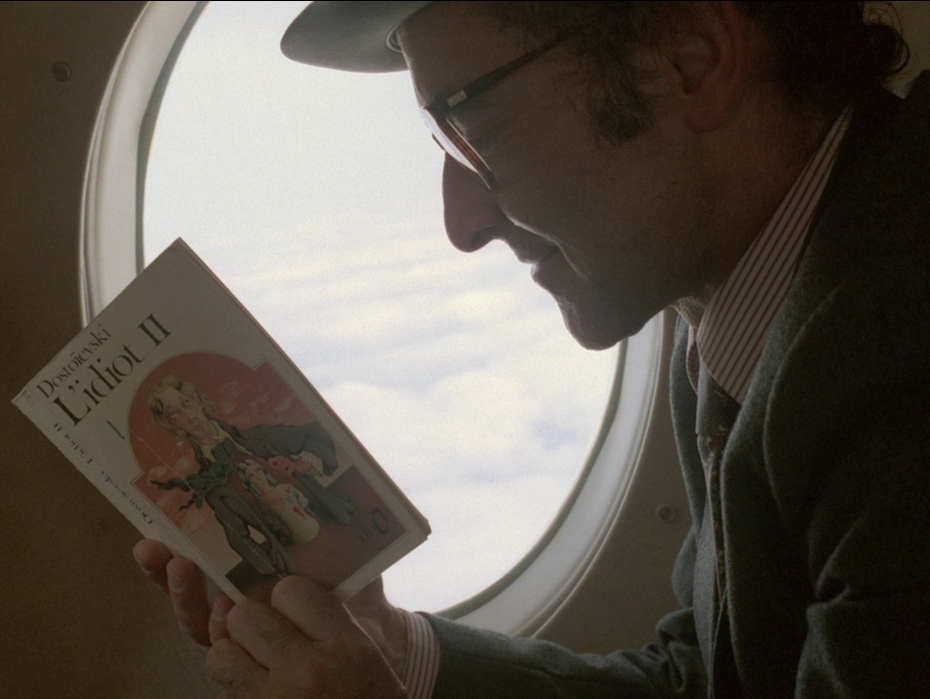
The nature of my particular fanaticism is such that I prefer to enjoy. So long as it should prove to remain possible, viable. It pleases me to enjoy. I prefer it to the gloomy alternative. That pleasure is pleasing and fun is fun: small children not only grasp these tautologies, they are known to be quite declarative about it. What happens to us? Along the way? There are people out there who only like Scandinavian black metal, K-pop boy bands, or Italian opera. It would not surprise me in the least if out there somewhere exists some fellow who of all the things in this bountiful world only likes Stan Getz live in Stockholm. The onetime Playboy associate editor, Discordian prankster, and psychonaut Robert Anton Wilson liked to perorate on the subject of individual “reality-tunnels,” and we might simply conclude—perhaps too simply—that the issue is one relating to narrowing with respect to these tunnels. We might think of it as a myopia of progressive concretion. It is commonly believed that old people don’t like anything new. Here is one of my favourite passages from any book ever, which one can find in Robert Anton Wilson’s Cosmic Trigger I: The Final Secret of the Illuminati: “Since we all create our habitual reality-tunnels, either consciously and intelligently or unconsciously and mechanically, I prefer to create for each hour the happiest, funniest and most romantic reality-tunnel consistent with the signals my brain apprehends. I feel sorry for people who persistently organize experience into sad, dreary and hopeless reality-tunnels, and try to show them how to break that bad habit, but I don’t feel any masochistic duty to share their misery.” The funny thing about this quotation is that you can share it with, like, one thousands people—as I am sure I have done in my work with my fellow alcoholics and addicts in and outside of a treatment context—and nine-hundred-ninety-nine of them will nod vigorously, maybe even say something approximating “far out man”...then proceed to do absolutely nothing with what they have just pretended to learn. Behaviourists have been telling us for a good while that people don’t want to change their thinking because they believe it is close to the whole of who they are. Challenged on core beliefs and values, people see red, detect an existential threat—the midbrain kicks in. This is the hopelessness of the human being, equivalent to a trout flopping in a motor boat with a hook in its gums. Your programming has tribalized you, you are caught, the platitudes you trumpet not properly your speech. What are the things you like? What is to your taste? Okay, stop talking, you bore me. If I do generally tend to find individual human beings monumentally tiresome, my particular fanaticism habitually directs itself toward an effort to try and enjoy the things human individuals make, alone or in groups. We are talking about specific varieties of things. We are most especially talking about writing, cinema, and music. I want to enjoy these things and appear to have better success than most people, especially professional (ahem) critics. That being said, sometimes, yes, it is all but impossible to enjoy. If I go and see a very bad movie—one I believe to be woefully inept, gratingly tedious, or totally objectionable—my last resort is to revert to sociologist or anthropologist mode, simply trying to figure out what garbled claptrap the bad movie might be expressing about the world in which I live. It is now bad, maybe very bad, so it becomes a patient, and I try to be as patient as I can with the patient, and may earn for my trouble a better command of aliments, which is something I might actually sort of enjoy. When attending two film festivals this past September (and early October), both from my couch (COVID-19 brought Toronto to me) and in theatres (masked and distanced), I did a very good job of enjoying everything, even the things I had to enjoy as a slightly exasperated clinician. The least satisfactory film I streamed from Toronto was a pretty good film that I would probably be willing to recommend: True Mothers by Naomi Kawase. Now, I do not at all think that Naomi Kawase is a bad filmmaker or that her story is bullshit or unworthy (even if it is not terribly original). What becomes a bit depressing for me watching True Mothers mostly pertains to the ways Kawase diverts from her strengths in order to enter territory outside her wheelhouse. This is going to be a problem for somebody who is basically enjoying the film and wants to keep enjoying it. Kawase is not a sophisticated or a manipulative director, at least not when she plays on her strengths. I think of her doing her work directly with the actors, the camera a little off to the side, unobtrusive, the work a work with the possibilities of intimacy and uniquely capable of seducing singular interactions and expressive affects into being. Problems start to accrue in True Mothers’ second third because the power source of the poiesis is cut off by the too-fancy insinuation of structural convolutions and an excess of scenes/sequences that seem to be purely illustrative within the schematic. A work is most likely to lose me if it starts to lose credibility within the parameters of the terms which would appear to be those set by the work itself, rather than its not conforming to a model I have of how all or most works ought to conduct themselves. If you have seen Charlie Kaufman’s most recent film I'm Thinking of Ending Things, a sort of psychogenic rockslide largely framed by the failure of framing, you will be aware of the already notorious scene in which the unstable plurality (mostly) embodied by Jessie Buckley begins reciting as though extemporaneously the famous New Yorker of yesteryear Pauline Kael’s demoralizing pan of John Cassavettes’s 1974 masterpiece A Woman Under the Influence, this being a review that happens to be contained in a Kael collection conspicuously placed earlier in the childhood bedroom of the boyfriend on the receiving end of the embezzled tirade. The review is so hideous as to represent something close to dereliction of duty. A key piece of prosody here involves the sardonic assertion that Gena Rowlands’s performance is something like the “most transient big performance” ever, this a capstone to Kael more or less telling us that what she really objects to is flux itself, as though there were or ought to be no such thing. Well, Cassavettes and Rowlands (and me and Félix Guattari) could not disagree more. The odious David Denby, current New Yorker hack, writes about this scene from I'm Thinking of Ending Things in his review of Kaufman’s film, likewise resorting to the sardonic Kael-lite modality. The narrowness of Denby’s reality-tunnel asserts itself as it always does. Sorry, I'm Thinking of Ending Things is not Stan Getz live in Stockholm. For shame, Charlie Kaufman. Why do I read? Or go to the movies or listen to music? Susan Sontag, abjuring interpretation, rhapsodizes on the erotics of our encounters with art and the products of culture. I want to keep expanding through absorptive self-relation, pulling everything inward, blowing up like Violet Beauregarde in Willy Wonka, Jack H. Harris’s Blob, or the increasingly giant gluttonous woman who tramples over the narrow and narrow-minded small town set and setting of Robert Coover’s John's Wife, that greatest of American novels. My position as to why this is my fancy: I am a special kind of idiot, if not to say a holy fool. Not quite like the Dostoevskian idiot archetypes the great Jean-Luc Godard shows us in his films Soigne ta droite (1987) and King Lear (the same year), if only because a great deal more pleased to be pleased. I think I am more like Dostoevsky’s actual Myschkin, who exists in something close to a state of permanent hyper-stimulated ecstasy. I would caution you to not get too fanciful a notion in your head about what the life or origin story of such an idiot might look like. Communicating online with the filmmaker Jon Jost in the wee hours of the morning, I wrote both of how “my life (in my twenties and a little beyond) was for a considerable period a harrowing nightmare for those tasked by providence with having to love or try to love me,” and of how still now, nearly seven years clean and sober, a special kind of idiot, “People very frequently look at me as though they believe I must be walking around with a pant leg full of my own shit.” Jost responded thusly: “We special kinds of idiots are a tiny minority. And we tend to know it, for better or worse. Many cannot handle it and destroy themselves with booze or drugs or suicide. Some can handle it and make the most of it with whatever they can do. Often in the arts. Sometimes in sciences.” Jost knows. My idiocy is instrumental irony. It is a medicine taken primarily in the form of what I tell myself with nobody else around and how I set out to engineer my pleasure. Jost’s “special kinds of idiots” who constitute “a tiny minority” are the minor persons Curtis White calls “transcendentally stupid” in his recent book Living in a World That Can't Be Fixed: Reimagining Counterculture Today. The world excludes you as too stupid to embrace the platitudes, too intransigent to narrow, and you are blessed. You can have your own expansive scene. You can metaprogram yourself as moulder of your own neuroplasticity. Transcendental stupidity? Consider how French literary theorist Fernand Hallyn assesses metatropological irony in The Poetic Structure of the World: Copernicus and Kepler: “The subject is placed in a transcendent position with respect to his discourse, but only to deny the possibility of making himself the guarantor of transcendence.” Instrumental irony can play inventively with the seat of the absent guarantor. In the novel I am reading right now, Alfred Hayes’s The End of Me, a fallen man in his late fifties, formerly successful, who happens to be the narrator, reeling in the aftermath of a marital cuckolding, beholds in his young cousin (once removed) intimations of an ultimate reckoning. Asher, the narrator, momentarily projects young cousin Michael outside of the domain of immediately accessible sense-data. “He is playing an ironic game with himself as he comes down the corridor. He is in enemy country.” The ironic game that is imagined, if only faintly: what might be its aim? Michael enters Asher’s hotel room and refuses to remove his overcoat. “Did he remove it only under direct orders from a superior? Superior what? Superior who?” What if the ironist’s “Superior who” is just some idiot? Anything could be in the offing. This is the divining index of young Michael’s diabolic potency. Do I myself carry an idiot with me in order to commit crimes and misdemeanours? If so…only incidentally, really. I first had to be an idiot because I must have intuited that it was a viable alternative to addiction, misery, and suicide. I continue because it is simply a fucking gas.


Sunday, October 11, 2020

Chronoclasm: A Historical Codicil

 Lee Harvey Oswald shot by Jack Ruby, June 28, 1914


Wednesday, October 7, 2020

Open University for the Trans-Armies Database & Future Classics: cinetagmatics_011

It is about Rita. This. This is. About Rita. And the longest Autumn on record. You’re going to say it's my fault. Not my fault. Mother built a Latin American Orphanage. Brought me back Quetzalteco Brain Fever with the commemorative t-shirt. Heavy sinuses afollowing. Down many days. I would have called. Christ, Jesus. It was just not possible under the suns of that particularly blurry Wednesday, Thursday and Friday. Sickness sometimes requires much.… You know all too well. What with your sad pancreas as it is. It was the ex’s fault. I mean your ex-wife’s fault. Rita. It would be your ex-wife out of the two of us. You know that I have no ex-wife. Only a dead one. That’s the first thing she had said. She said so. When she came by. Said she was your ex-wife. Rita. No. Go away. Well your ex-wife: she didn’t listen. That horrible thing of being so locked in a situation, and so much so that you can’t get out of it a second to think, and then add being sick on top of it. You can’t think to think. I just stood there not thinking. Your ex-wife, Rita Hayworth, noting this, staked the place bare, took over, blossomed out nuisances. I know I didn’t call to ask, but why? how come? How come unleash your ex-wife, my fever and all? It’s not my fault. I couldn’t stop her. You know how…. Your ex-wife Rita Hayworth said there were going to be changes. Dusted off the furniture in her work clothes. Inspected the fridge incredulously. Roused my three daughters from bed. Made them cook breakfast. I eyed your ex-wife the whole while. I had to admit that she was not unappealing. What with her curvatures and embankments. I wash my car, she was complaining, not twenty minutes, bird shits on it. She proceeded to kick my dogs angrily, the slower ones anyway. My darling daughters brought forth the bacon and best china. Your ex-wife glared at the food, refusing to eat, pointlessly working into her gums with a toothpick. When exactly, she asked, do you intended to mow the lawn? Upon hearing that I paid a thirteen-year-old boy from the neighbourhood to tend to such things she threw a vase. Urinated on the rug. Insulted my profession. I did not intend to make love to your ex-wife Rita Hayworth. Should have called. I had just gotten over the Guatemalan mind worm. I wish you would have called, though. Put an end to it. Put your lawyers back in contact with hers. Nothing like lawyers to have stopped me pulling off her pajama bottoms. Even just the phone call, really. Maybe then I wouldn’t have come to find your ex-wife most expert in pants and thrusts, having thusly turned my home and three daughters over to her. She put in a new microwave stolen from apartment six in your building. Heating herself a breakfast burrito. Disparaging my daughters and their stubby, most unculinary fingers. Sue looked at her fingers and cried. Beverly-Anne crawled into the fireplace and sooted herself. Angela stared down your ex-wife like a water buffalo. I did the vacuuming as promised. Soon there was a thunderstorm and the power went out. The girls clustered by the fire pit, shakily in arms. The vacuum cleaner purred to sleep. The dogs cried out. The hail hit the windows and shutters like birds. Your ex-wife asked the whereabouts of the attic with its candles and emergency supplies. I had to admit that I had no idea, as that sort of thing only my sadly-no-more-Sally would know. That’s the sort of thing. That’s the sort of thing Sally. Your ex-wife. Rita Hayworth. Was furious just then, exposing her perfect teeth. They became the only things visible in the room. My daughters, cowering, saw her fragmented beating of me through sharp blasts of lightning. I had a dream in which there was a famous painter about whom I was curious and then it turned out that he was me. Sue revived me with smelling salts. First thing I noticed was aural. Soft patter of rain. On the shingles. The whining animals. I became aware. A living room full of: empty pizza boxes: champagne bottles. Curtains burned to crisps. I registered in full that the stink from the rug was awful. There was pasta sauce on the walls. Bird shit everywhere. Sue’s bonnet wore a wreath of cigarette burns. Angela, it seemed, was dead. Beverly-Anne clutched the remains of her dolly and stared into oblivion, clearly shocked to the bare shell. I looked at them briefly and then for your ex-wife. I knew, instinctively, that she was gone. I was too weak from the pummelling to move very far. I crawled for as long as I could. Finally my face dropped with a thud somewhere in the blur of tile. I cried, just then, for your ex-wife. I cried for Rita. The empty house echoed with crazed sobbing. The floorboards rumbled. I cried for missed affection. I cried and I cried. I cried for your ex-wife. Then the phone rang. I picked it up. It was not your ex-wife, as I had hoped and as you well know. Amidst the din of this disaster, the grave of this work, the daughter who may be dead, the stains of pasta sauce that I now suddenly realize may not be pasta sauce at all, the shattered photo at my feet of my sadly-no-more-Sally…there is only one thing I can summon to ask, with the very last of myself, knees aching so: why didn’t you call? now that they’ll blame me…her not even being mine and…why? why me? Well, I guess the stars just aren’t on your side you said just then. And I guess I have to agree. This. This week. This week the longest Autumn on record.


Wednesday, September 30, 2020

Open University for the Trans-Armies Database & Future Classics: cinetagmatics_010

It pleases me very much to be able to claim on this, the last day of September, that the month has been a stimulating and rewarding one, though most all of them are nowadays. If September was not more rewarding than is customary at this point, it is at least deserving of special distinction on account of its having offered me the opportunity to attend (in a manner of speaking) two film festivals within the context of a drastically transformed landscape. Planet X, Year COVID. Select selections of the Toronto International Film Festival were earlier this month made available for the first time to Canadians far and wide, and I partook of six comically costly streams. One of them, Chaitanya Tamhane’s The Disciple, now my favourite of those I dialed in from Toronto, subsequently became announced as a late edition to the Calgary International Film Festival, which commenced Thursday of last week, and I got to see Tamhane’s film a second time Monday night, this time in a theatre, enjoying it approximately a thousandfold. Much more can and perhaps at some point will be written about all this. Of the just-over-fifty films I have watched for the first time or revisited in September, only fourteen have been festival streamers or live festival theatricals (with two more of the latter on the docket for later today). One of the most critical not-festival-related cinematic felicities this month was the arrival of the new Criterion Blu-ray of Claire Denis’ monumental 1999 film Beau travail, finally available for convenient serial revisitation in the form of a 4K transfer presented at 1080p resolution. I have been a huge Claire Denis fan since a little before Beau travail came out, but for whatever reason I did not have the opportunity to experience the theatrical presentation of her most widely-regarded film during its original run near the end of the 20th century. It would certainly have played Ottawa. Perhaps I simply wasn’t in town. At any rate, upon scoping the Blu-ray, it becomes exceedingly apparent how utterly insufficient were the previous transfers of the film I have had occasion to view, that featured on the 2002 New Yorker DVD most especially. I have long prized Denis and her regular cinematographer Agnès Godard as the finest team in the business, and I am gratified to have finally been able to properly appraise the scale of their considerable achievement(s) on Beau travail. Many will be aware that Denis has a bit of a reputation as both a tight-lipped and an intermittently brusque interviewee. I recall not too terribly long ago a Facebook friend having shared a profile on the great director in which she, Denis, disparages critics and film theorists, only to have many responding to the post, some themselves critics and theorists, express, predictably, their ire. Touchy people. Fuck ‘em. Though Denis will regularly talk about the primacy of the human body in her cinema, she will likewise often become annoyed with commentators who discuss the sensual or corporeal nature of her films. Her issue—and I believe it more than merely legitimate—is with the reductive language brought to bear by those who can only manage to espy a bare minimum of the proffered spectrum. And utilitarian language, a bit of a hassle at the best of time, is not ever going to cut it. Otherwise you would get into the blocks of language racket as opposed to the blocks of image-sound one. Note how the great Robert Bresson, master filmmaker and precept man, puts it in an interview with Michel Ciment shortly after the release of what would prove to be Bobby B.’s final film: “I seek not description but vision. A sense of motion comes from building a series of visions and fitting them together. It is not really sayable in words. Increasingly, what I am after—and with L'argent it became almost a working method—is to communicate the impressions I feel. It is the impression of a thing and not the thing itself that matters. The real is something we make for ourselves. Everyone has their own. There is the real and there is our version of it.” Yes, Denis and Agnès Godard have a special capacity to capture the body and its movements, but they do so from the position of a holistic discipline of poiesis fielded by and within resonance. They are in synch with bodies, with minds, with spirits, and with a tradition in and beyond the arts. The work is primarily intuitive (impressions, renderings), and the intelligence is an intelligence of and through the cinema, not an intelligence of finessed discourse and exculpatory explanations. Denis makes great cinema that is unmistakable as anything other than cinema. If she is attracted to the haptic—the feel of a leather jacket, say, or the smell of wet hair—she is likewise attracted to Herman Meville, whose Billy Budd is the key jumping off point for Beau travail, William Faulkner, whose Sanctuary serves the same function in Les salauds (2013), and Clarice Lispector, whose The Hour of the Star I believe is being consciously homaged in the final sequence of Un beau soleil intérieur (2017), a film initially undertaken as a way of reimagining the taxonomies of Roland Barthes’ A Lover's Discourse. The literary enters into the cinema of Claire Denis by way of a perversion assuming the modality of something analogous to biochemical adaptation. When commentators insist on zeroing in on corporeality, sexuality, and sociality to the exclusion of all other considerations, they cut off the very rich poetics and the entire domain of metaphysics, Denis’ cosmicity, even when she is so bold and unambiguous as to set a film (2018’s High Life) in outer fucking space. Take as a not-especially-egregious example the scholar Judith Mayne, author of a 2005 book on the filmmaker, who has provided a video essay for the Criterion release of Beau travail. A key example of Mayne’s tendency toward unsatisfactory reduction can be found in her assessment of the film in question’s bravura opening sequence, a series of fragments or a montage drawing together a plurality of space-times and regimes of semiosis. Pay special attention to the manner in which Mayne addresses a single critical shot which superimposes the journal of Denis Lavant’s character Galoup, source of Beau travail’s intermittent voiceover, and a shot of the undulating sea. Mayne: “The rippling sea water suggests both calm and potential turbulence. Galoup’s writing, from his place of exile in Marseilles, with the water superimposed on it, suggests that his journal is an idealized recollection of the Legionaries as well as an attempt to understand his actions.” While there is doubtlessly something to “calm and potential turbulence,” Mayne's concluding assertion regarding “idealized recollection” and an “attempt to understand […] actions,” is psychologizing hogwash that reflects a film culture no longer interested in or able to take into account metaphysics or poetics. The superimposition immediately hearkens back to the cinema of Jean Epstein, a pioneer for whom both superimposition and the sea assume their respective places of primacy as pertains to a cinematic metaphysics, as in the 1928 Poe adaptation La chute de la maison Usher, where the deceased beloved has been reconstituted into a presiding planetary vitalism, most forcefully manifested by wind and tide, themselves expressive phenomenal manifolds of humbling scale reflecting both Kant’s concept of the sublime and Henri Bergson’s concept of élan vital. The sea is always élan vital within a certain field of French poetics. The great many cutaways to waves rolling into shore or of the horizon line of sea and sky in the films of Jean-Luce Godard, especially those made in collaboration with Anne-Marie Miéville, should always evoke Bergson and Epstein for us just as they evoke the intersubjective heave of Virginia Woolf's The Waves. Judith Mayne speaks in her video essay of Denis Levant’s “pent up energy and release” or how Michel Subor is “solid and wise” or “quiet and solid,” and she believes she is only talking about bodies and gender, not of the universe and comportment within the universe, not of élan vital, drives that are merely provisionally localized in the body, the blockages and flows. Mayne can express how the explosion of Levant’s Galoup into aleatory dance at the conclusion of the film is presaged moments before by a lingering shot (famous and astonishing) which captures a vein pulsing in Levant’s arm, but it would never for a moment dawn on her that this too is of the same elemental stuff as are the sea and the wind. It is not for nothing that it is Galoup’s notebook that is superimposed over the sea (or vice versa). The notebook and sea situate the instantiation of the creative and/or reflective act, the vital force married inextricably to poiesis. This is the territory of Gaston Bachelard, author both of Water and Dreams and The Poetics of Space. Early in the latter book, Bachelard draws special attention to a formulation from Pierre-Jean Jouve: “Poetry is a soul inaugurating a form.” That is what Denis is figuring-forth with her superimposition and it is the work that her cinema has more broadly taken on. For Bachelard, the poetic soul “upsets the plans of the usual psychological explanations,” and rests in what Denis’ superimposition is already proclaiming: “infinite quality of the intimate dimension,” Bachelard later expanding this to qualify that “intimate space and exterior space keep encouraging each other, as it were, in their growth.” Attention is paid to an “astonishing variety of uses” to which Baudelaire puts the word “vast” and how the poet’s reverie “gathers the universe together around and in an object.” The image for Bachelard is a product of the imagination, not a photographic reproduction. The images in Claire Denis’ work with Agnès Godard are photographic reproductions of the imagination’s images in a context where those original images, those of the imagination and its poetics, have to be a product of lived encounters, a dance performed, largely intuitively, by a collaborative unit. This is why these films are more than merely corporeality, sexuality, and sociality. They are more properly a gathering together of the universe around and in themselves. A curious counterpoint can be found in an interesting though not especially strong film I streamed on Friday (care of the Calgary International Film Festival). Lawrence Michael Levine’s new film Black Bear, a good deal more prosaic than the Denis though obviously more than a little enamoured of its inventiveness, is a brokeback film whose two opposed halves are intended to produce a dialogic synthesis via their incorporation within a single field of sense. At first we have a very recognizable indie template, three people squaring off in a remote residence, eminently palatial. These three are large on smart-talk, low on credibility, sharing as such the attributes and the defects of their writer-director. Black Bear pulls an about-face at roughly the halfway point and the palatial residence is now configured within a new self-reflexive regime complete with a corresponding slippage of personages. The eponymous bear will show up in the late going, an agent of something like tenuous metaphysical interlacing, perhaps somewhat similar to the African woman first seen hawking her own rugs in Beau travail, originally situated curiously outside of the governing schematic, who returns later on to minister to the nearly dead Sentain (played by Grégoire Colin). Black Bear is idea-heavy (as in "high concept") and one senses that it has lost much of its promise at each stage of its development, entering into problems on the page, ultimately losing all or most of its moxie in production. It is mostly fatuous. It is pretty clumsy. Its intelligence is about tricks not about the things in the world or the frame that worlds. What is curious here, though, is that Black Bear has ended up back at the page, the final sequence endearing itself to me as such. We end with the film’s star Aubrey Plaza returning to her desk, opening her notebook, and commencing to write what we can only imagine will be the film we have just watched. The closing credits are themselves superimposed over lined notebook pages. The film has gone off the rails and probably never had much of a chance, too full of hot air from nearly to word go, but in returning to the page it returns to the site where it once experienced the intensifying onslaught of its own generative promise. The page is the instantiation of the creative act. The page is the universe. The page, to hijack a precept from Judith Mayne’s Beau travail video essay, is the neutral face of Greta Garbo. It promises. It receives our projections.     


Wednesday, September 23, 2020

Open University for the Trans-Armies Database & Future Classics: cinetagmatics_009

First and prime-motherfuckin’-airily: it is too stupid for words to outsource your own sense of worth. Strong words, okay. But what, pray tell, backs them up? Good question. Almost sounds like you’re on to me. It might increasingly strike the reader that I open myself to charges of solipsism. This might be a good time to make the case that the enunciative “I” here, gendered merely for expedience, works in a laboratory and observes human phenomena germane to a set field of study, though one that is generously open-ended. Aldous Huxley praised D. H. Lawrence for writing novels with no characters in them. D. H. Lawrence was a lab technician. If I come along with the imposture of a “proper name” with its capacity to provisionally constellate, there are no shortage of such names floating around in Lawrence either…and in the case of both D.H. Lawrence and myself: not all of these phenomena are especially pretty. I wrote a large book of small essays last year. It is called Bottomless Casket: A Year in Books and it is not actually itself a book because it is only a manuscript which I have half-assed shopped about and which, in the year of COVID, I cannot get so much as officially rejected. Is there a person I observe—or some thing or set of things relatively like a person—whose ego is bruised? It’s not nearly that simple. The answer “yes and no” hardly seems to cut it. Let’s note two things, the second already a repetition: 1) the work is a life; 2) it is too stupid for words to outsource your own sense of worth. That being said, something compelled me this past week to send the manuscript to an old friend I have neither seen nor in any way contacted (or been contacted by) in many years. Back in Ottawa at the turn of the century, this friend and I were impossible larger-than-life marauders who, upon reflection, strike even myself as escapees from the asylum of fiction, a challenge to so much as credit as flesh and bone (which those two young people obviously no longer are). He is now a professor out East, married to his second wife, and owner, he tells me in his first of two rapidly-dispatched emails, of a mortgage-free house in the burbs. Okay. I suddenly felt like I needed to send this friend my large more or less abandoned manuscript. Though all of my various deflective statements absolutely tell their truth too, I will confess to having been highly gratified to have received the second email from my old friend half an hour after I had sent my first. He had just boarded a train, he wrote, and, having his tablet along with him, had already made serious headway with my manuscript, which had him “hooked.” He offered me meaningful praise, and his meaningful praise meant. It meant for me and I felt it mean for me. “And, on those many occasions you allude to where it was like you were pretty much out of time, on death's proverbial porchway,” he writes, “you had nothing but time + books. And maybe because, in the long hospital and psych ward and rehabilitation clinic times when one is contained and/or hooked up to a machine (literally and figuratively), a flitting of consciousness here and there permitting that one thing that was the only worthwhile thing to be permissible: read, read, read.” Right. That is right. He continues. “Everything outside is busy, people rushing about, chasing things, deploying small plans, always trying to strategize just an hour ahead of themselves, but there you were, active in mind but not in body. No, I'm not courting old dualism except as a matter of point. Only the fastest minds know how to slow the fuck down.” I am not quite sure how clear it is or will be to readers what my friend means by “the machine,” especially its figurative aspect. (He has been going on about the machine and the machinic since I met him in the 1990s.) The literal meaning is pretty simple. During late stage alcoholism/addiction I spent a lot of time in hospitals hooked up to IV drips and monitors. To explain what it is to become uncoupled from the figurative machine and what that might have to do with a superpower my friend attributes to me—which is indeed a superpower I possess—probably requires more explanation, which I would like to begin providing by backtracking ever so slightly. Bottomless Casket: A Year in Books is comprised of 101 essays I wrote in 2019 corresponding to each of the 101 books I read that year. I knew the fact that I originally shared all of these essays on the social media site Goodreads probably made the whole thing seem dubious in the extreme, such that it became my reckoning that I needed to provide a gangbusters Introduction capable of making with the heavy suasion. So that is what I did. The Introduction incorporates close consideration(s) of the 1948 film Portrait of Jennie, which is approached from a number of angles and made to bounce off the text (my manuscript) and the contexts of the text (which is framed as bound-up in work set on pursuing recovery by idiosyncratic means). The eponymous Jennie, played by the great actress Jennifer Jones, is a revenant, a solid and material being capable of (and available for) direct physical intimacy who just so happens to have died approximately two decades before she enters the story, gallivanting childlike in Central Park in 1940s-anachronistic Puritan regalia. In my Introduction, I address how the revenant figure occupies an abstract line, the third synthesis of time conceptualized in philosopher Gilles Deleuze’s 1968 book Difference and Repetition. Now, if the figurative machine, a device of capture making use of the variegated apparatus of daily life in the social field into which one finds oneself haplessly flung, subsists primarily on the first two syntheses of time, those relating to habit and memory, the abstract line is where the indolent supplicant who reads may perhaps have an opportunity to uncouple, making efficacious use of a temporal regime zigzagging parallel, in colloquy with revenants, both teachers of return and agents of the immediately accessible living eternal (the only eternal available to us). In her essay/lecture “Nationalism and the Imagination,” Gayatri Chakravorty Spivak extrapolates forward from Roman Jakobson’s argument that the experience of “equivalence” is the key mobilizer of the poetic function. Spivak wants to inaugurate an “inventive equivalence” employed in such a way that it might be able to undo the “possessive spell.” It is this “possessive spell” that I believe we could argue is what is produced and reproduced as long as we are coupled to the figurative machine. The imaginative utilization of an abstract line may allow us to decouple in such a way that we are able to take back possession of possession itself. The imagination is not the caster of spells but rather the tool we can use to break them, and that is how the speedy mind slows itself down…precisely in its newly achieved authority over the spells originally imposed from without. As somebody who has suffered from mania and manic psychosis, I have lived the experience of the speed getting on top of me, of its poisonous usurpation of agential governance, triumph of fateful (perhaps fatal) allegro. Much of my fiction has dealt with the spree and I have always responded to literary fiction fixated on spree. Spree is the diabolic interpolation of an alien and annihilating will. When you are in spree it is too late to slow down. You’ve been caught, you have to ride it out. There are two perfect novels on the subject by American writers that immediately come to mind, Stanley Elkin’s The MacGuffin from 1991, a brilliant and hellacious comic novel with no chapter breaks (or even breathing breaks) about the marauding coca leaf-chewing street commissioner Bobbo Druff, and John Hawkes’s Travesty from 1976, a protracted monological nightmare about a logorrhoea that is prelude to a monstrously deferred vehicular murder-suicide. As an alcoholic with a proneness toward manic psychosis, I can relate to Travesty all too well, having for a long while unwittingly fashioned of my life a harrowing hostage situation. Books can put me on and ventriloquize me in a manner altogether Satanic. Punctuation marks seem at times principally to exist as necessary breaks, like those incorporated into the engineering of motor vehicles, preventing the whole enterprise from cartwheeling off into void. A book can slow you down betimes, surely, but my powers of adagio and lento, the contra to allegro, those my friend notes in his praise of my manuscript, are, I should think, more reliably ministered to by the cinema, which will again bring me to Jennifer Jones, a revenant dead since 2009, no matter what character she is playing. What is crucial here and is always crucial is above all the actress. The actress has always been my principal point of identification in the cinema. Dating back to the dawn of film as a domain of legitimate academic study, we owe to the feminist scholar Laura Mulvey and her cohort the implementation of a macrotextual schematic that couples the cinematic apparatus to the male gaze and situates the woman within the context of the bondage of to-be-looked-at-ness. However, my identification with the woman is my identification with the apparatus, and what cannot be nullified here is the potency of her gaze. Think of films where we have a privileged view of an actress gazing directly into the camera. Harriet Andersson in Ingmar Bergman’s Summer with Monika (1953), Setsuko Hara in various film by Yasujirō Ozu, Alicia Vikander in Wim Wenders’s Submergence (2017). The actress looking directly at the camera is not looking at me, merely at the camera, I am not there for that gaze even as I am, the actress likewise receiving my gaze with no knowledge of my existence, no consciousness of its displaced, individuated presence. It is common to frame these matters in terms of scopophilia, gendered imbalance, but what I experience is a complementarity that immediately provides a space—contingent upon the working of an abstract line—for precisely what Spivak calls “inventive equivalence.” This is already a matter of magic and it compliments the magic that is the breaking of the spell, the uncoupling from the figurative machine, the radical re-territorialization of identification, the slowing the fuck down. 'Tis assuredly the case that my favourite movie stars born in the first decade of the 20th century are Marlene Dietrich and Louise Brooks, but it has taken me longer than it ought to have to realize that Jennifer Jones, born the same year as my maternal grandfather, stands alone as the finest born in the second. Two of her greatest films, Cluny Brown (1946) and Gone to Earth (1950), are about the achievement of a line-of-flight, a key concept in Gilles Deleuze and Félix Guattari’s work on schizoanalysis, categorizing as it does a species of phenomena relating to the forging of connections and the opening of new passages that subvert the impositions of the binary apparatus and as such the figurative machine (the machine that is all those mechanisms with which the social field would set out to figure you). In the long-unpublished interview with Deleuze and Guattari conducted by film scholar Raymond Bellour finally made available in English this past summer (in Letters and Other Texts, the final of three collections of Deleuze minutiae brought to us by Semiotext(e)), the two interviewees repeatedly make the assertion that schizoanaysis believes and wants to communicate a belief in the right to nonsense. While Lewis Carroll and Antonin Artaud are of course patron saints for this school of advocacy, might not the declarative “squirrels to the nuts!” from Lubitsch’s Cluny Brown serve as its battle cry. However, if you really want the revenant Jennifer Jones, the teacher first of return, secondarily of adagio and lento, you could not conceivably do better than 1943’s The Song of Bernadette, the film that sent her supernova. It ends with dying, but this is a dying that communicates its profound dignity and superhuman forbearance through the face and the gaze by means of an economy of affect. Sister Bernadette, a saint, a worker of miracles, is dying of tuberculosis of the bone, a brutal and agonizing way to go, but you’d never know it, just as the cruel Sister Vauzou, who believes her charge a fraud, does not know it. Upon realizing what Bernadette has withstood so serenely, Sister Vauzou is struck with holy awe, absolutely converted, the viewer’s (certainly this one’s!) conversion already long a done deal. Jennifer Jones is not dying of tuberculosis of the bone during the production of The Song of Bernadette. Still, what her face offers us is precisely the communicable neutralization of the intensities a novel like John Hawkes’s Travesty so effusively performs.